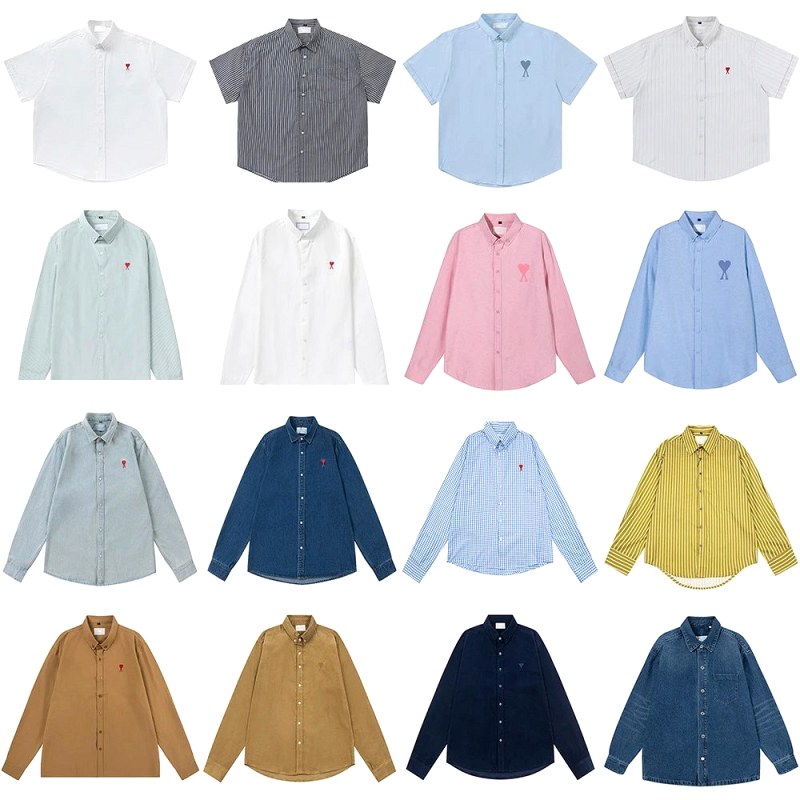
What we ordered from the listing
The listing is one product page with one SKU (7702007271) and a colour list that runs to 36 entries, so the first job was working out what actually ships. We ordered five units: sizes S, L and XL in the solid white code 827#, plus a size L in the blue check code 837# and a spare L in 827# for repeat measurement. Each parcel arrived at the Rotterdam office, was photographed before opening and again after consolidation, then opened on the same measuring mat where we weigh and lightbox everything else we test. Listed price is $29.40 in stock, down from $30.87.
The catalog weight field for this item reads 0.00, which tells us nothing about shipping. Our scale is the useful number: the single tops landed between 243 g and 291 g depending on size, so a five-piece haul of this style costs roughly 1.4 kg in postage before packaging. Use our figures, not the listing's, when you run line-rate maths.
Sizing: the S–XL block grades wide, the sleeve barely grades
We measure every garment flat across the chest, waist/hem, sleeve and body length, and compare each number with the listed chart. Here is what our three 827# units came back with, laid flat without stretching.
| Size ordered | Chest, flat | Hem, flat | Body length | Sleeve (shoulder to cuff) | Our scale |
|---|---|---|---|---|---|
| S — 827# | 54.0 cm | 54.5 cm | 66.0 cm | 60.0 cm | 243 g |
| L — 827# | 58.0 cm | 58.5 cm | 70.0 cm | 62.0 cm | 268 g |
| XL — 827# | 62.0 cm | 62.0 cm | 72.0 cm | 63.0 cm | 291 g |
| L — 837# (blue check) | 57.5 cm | 58.0 cm | 69.5 cm | 61.5 cm | 275 g |
Two things stand out. First, the grading is honest and even: 4 cm of chest per size step, and the hem tracks the chest almost exactly, so the top hangs straight rather than flaring. Second, the sleeve barely grades — 3 cm from S to XL, and just under 2 cm across the three sizes we could compare directly. On a long-sleeve piece, tall buyers who normally size up for arm length will not get it here. If you are over roughly 185 cm, expect the cuff to sit closer to the wrist bone than you are used to, and treat XL as a body-width upgrade rather than a length upgrade.
The medium in the blue check, sold as the same L, measured 0.5 cm narrower at the chest and 0.5 cm shorter than its white counterpart. That sits inside normal cut tolerance for a $29.40 woven top, but it is a reason to check the chart for the exact code you intend to buy rather than trusting the listing-level size table.
Reading the "60-count Oxford" claim against the cloth
Yarn count is not thread count. A 60 count (Ne 60) means 60 hanks of 840 yards per pound of yarn, so a higher number is a finer yarn — fine-shirting territory, not a heavy sport shirt. The description pairs that with Oxford cloth, which is a basket-weave construction, and textile classification places Oxford in roughly the 43–68 yarn-number band, so "60-count Oxford" is a coherent spec on paper rather than a contradiction.
Our bench test was simple: press the fabric flat over the lightbox and look for the Oxford basket repeat instead of a plain weave. On both codes the surface showed the characteristic waffle-like basket texture with slightly irregular thread crossings, not the flat grid a poplin substitute would give. That supports the Oxford naming. The fineness claim is consistent too — this is a light, softly translucent cloth, and against the white unit we could make out the shadow of mat lines under it. On a white top that means you should plan an underlayer, and on pale colourways expect the same. What we cannot verify is the fibre itself: the composition field reads "other", the specs list only "other fabric" and the material name "Oxford", with a breathable function claimed. If a wool, cotton or synthetic content matters to you, that has to come from your agent, not the page.
Collar, placket and chest embroidery under the 10x loupe
This is where the price shows, and mostly in a good way. The collar band measures about 4.5 cm with a 7.5 cm point; the interlining is soft and the points would not hold a hard crease, which is consistent with a lightly fused or unfused collar rather than a stiff shirt interlining — it reads relaxed, and it will move with the top rather than stand up on its own. The placket is a 3 cm band taking four matte, plastic-look buttons of roughly 15 mm; the buttonholes are cut cleanly with no fraying at the ends. We did not run a destructive test on the buttons to confirm the material.
The chest embroidery is the detail most likely to be used as a quality proxy, so we looked at the reverse as well. Stitch density is even across the motif, there is little puckering around the outline on any of the five units, and the reverse shows a clean finish without a large stabiliser patch showing through. Tonal thread is well matched to the ground on the white and check cloth. Nothing in our photo set establishes a defect here.
Thirty-six colour codes, but only two checks
The colour list is long enough that shoppers read it as one garment in 36 colours. It is closer to a family of codes that may not share a block. Grouping the entries by their code suffix:
| Code family | Colours listed | Pattern |
|---|---|---|
| 827#, 811#, 802#, 804#, 830#, 839# | white, light blue, light yellow, light green, pink, black | solids |
| 801#, 812#, 826#, 829#, 831#, 838#, 842#, 845# | pink, grey, blue, green, apricot, black, purple, yellow | stripes |
| 837# | pink, blue | checks |
| 835#, 816# | denim, light denim | washed/incl. denim tone |
| 832#, 833#, 836# | pink, coffee, blue, khaki, navy | solids |
Only 837# is described as a check, in pink and blue. The product name says "check multicolor T-shirt collection", and that is the gap: if you came for a check pattern, you have two codes to choose from, not 36. Codes with shared suffixes appear to share a base cloth and pattern, and we would compare the image set attached to each individual variant before ordering anything unusual — the listing-level photos are the same handful of shots reused across the range.
Heart logo, neck tag, and the honest limits of a $29.40 copy
Ami Paris pieces are heavily counterfeited, and the standard authentication checks centre on the weight and placement of the heart-logo lettering, plus the stitch spacing and alignment on the neck tag. We put all five tags under the loupe: tag stitching was even in spacing with no drift at the corners, and the logo bar weight looked consistent with the reference images we hold. That is a comparison against photographs, not an authentication, and the desk does not present it as one. At $29.40 against AMI retail, treat the chest motif as a design detail rather than a provenance claim.
"I went true to size with Large and the fit is perfect. Good length, sleeves sit nicely and overall just a clean summer fit." — buyer of a comparable Ami de Coeur tee, a different model from this listing. No buyer report covers this exact page, which is why we lean on our own flat measurements.
AMI's own guidance is to take your usual size, with labelled 42 landing at a typical Large, and reviewers consistently describe the house silhouette as boxy and relaxed. Our S–XL run is looser than that label suggests at the chest, so if you want the intended drape, take your usual size; size down only if you want it closer to the body.
What we would still confirm before ordering
- Which garment ships: the title says T-shirt collection, the attribute set describes a long-sleeve, lapel-collar cardigan in a loose cut. Ask your agent to confirm sleeve length and closure on the exact code.
- Fibre content, because the composition field reads "other" while the fabric name reads Oxford cloth.
- A QC photo set tied to your chosen colour code, with a ruler across the flat chest and a close shot of the neck tag and chest embroidery, taken in daylight rather than under warm warehouse lighting.
- Whether the check you want is available at all — 837# is the only checked code in the list.
Ordered, measured and photographed on our own table; the pieces here are the ones we are describing.