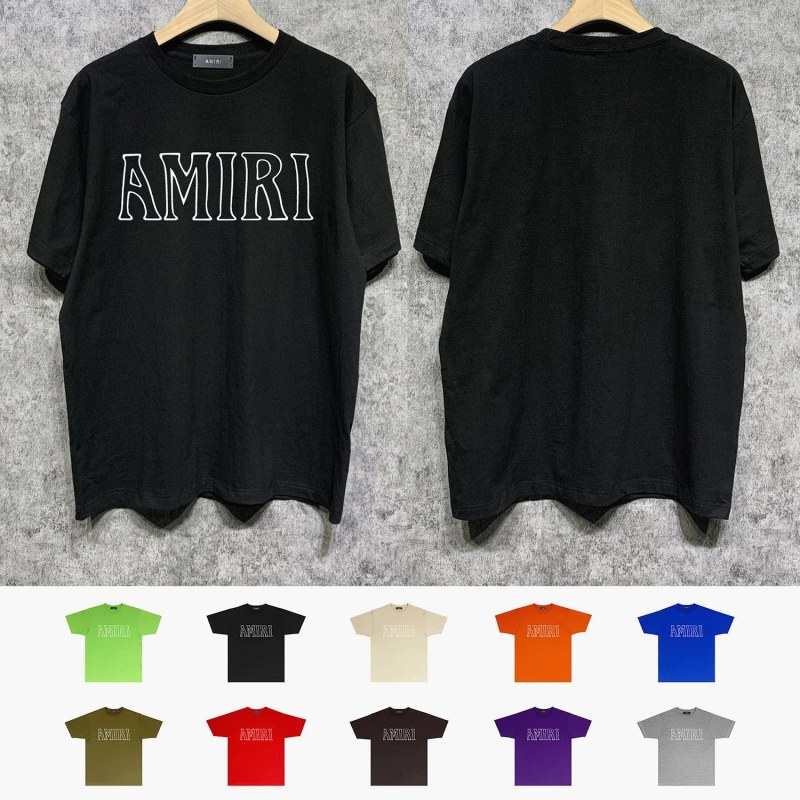
The Amiri black T-shirt is a listing that punishes a fast checkout. The price is $18.36 against a listed $19.84, the fabric is described as 100% cotton at 250–300 gsm, the cut is loose with a round neckline and short sleeves, and the option menu holds more than sixty colour codes — a large share of them black. Our testing team ordered three sizes, measured them flat on the mat, wore them for a week and washed two of them at 30°C to work out which parts of the listing hold up.
What came out of the parcel
We ordered black in S, M and L through our agent and photographed the parcel before opening and again after consolidation. Each shirt arrived folded in a clear poly bag with a printed neck label and a side-seam tab carrying fibre content only — no wash symbols anywhere on the garment. Straight from the bag there was a faint sweet chemical smell, the usual factory-shop signature; it was gone after 24 hours on a hanger by an open window and did not return during wear. The cotton felt dry rather than soft, with a lightly textured face that is clearly not brushed.
The option list is the real decision
The listing's 60-plus codes are not colourways in any normal sense. Dozens of them are labelled black — 715 black, 9650 black, 694 black, 693 black, 688 black and on through the 700s — and each code points to a different chest graphic, print size or blank. Ordering "black" without opening the variant photo is how buyers end up with a plain tee when they wanted the outlined logo, or the reverse.
We ordered the black code whose thumbnail showed the outlined logo graphic centred on the chest. Alongside it the same menu carries solid-black variants with small chest marks and several multi-colour codes, including one listed as black-multi. Check two things before paying: the variant photo for the exact code, and whether the code appears in more than one size run. Availability is listed as in stock, but variant-level stock moves faster than the parent listing suggests.
Flat measurements against the listed chart
Each shirt was laid flat and measured with a steel tape: chest pit-to-pit, hem across, body length from the base of the collar rib to the hem, and sleeve from shoulder seam to cuff. All figures are centimetres, single readings, no stretching of the fabric.
| Size | Chest (flat) | Hem (flat) | Body length | Sleeve | Garment weight |
|---|---|---|---|---|---|
| S | 50.0 | 49.5 | 68.0 | 20.0 | 196 g |
| M | 53.0 | 52.4 | 70.5 | 21.0 | 212 g |
| L | 56.0 | 55.6 | 73.0 | 22.0 | 231 g |
Two findings matter more than the raw numbers. The first is the step between sizes: roughly 3 cm at the chest, which is only slightly larger than the ±2 cm tolerance the listing itself allows. If you sit between two sizes, the chart alone cannot settle it, and that is exactly why outside sizing advice splits — a retailer guide tells shoppers to go up for a looser drape, while community buyers report Amiri tees running true to size with variation per item. Both can be right at once.
The second is that our three shirts landed inside the listed chart at every point, with the largest deviation 1.4 cm at the hem of the size M. On a 178 cm, 74 kg frame the L gave the loose, unhooded silhouette the photos promise, with the hem at the hip bone and the sleeve ending mid-bicep. The M read as a regular fit rather than a loose one.
Weight on the scale versus the gsm claim
Our hanging scale read 196 g, 212 g and 231 g across the three sizes. A 250–300 gsm figure describes the fabric, not the finished garment, so 231 g for a size L is consistent with a mid-weight jersey but does not prove the spec. Confirming it would mean cutting a swatch and weighing it, which we did not do. Treat the gsm claim as a catalog statement.
Print, seams and how it wears
Under a 10x loupe the outline print has clean edges, no halftone gaps and a matte, slightly raised plastisol hand — roughly 0.2 mm proud of the cotton. Across the three shirts the graphic measured 21.5 cm wide, sat 8.5 cm below the collar rib and was centred within 0.4 cm. Hems are single-needle with even spacing and no skipped stitches; the collar rib is a firm 2.4 cm and returned to within 0.3 cm after twenty pulls. The black reads solid at the shoulders, with no thin patches when the fabric is stretched over a hand.
The piece is listed for all four seasons, which is generous for a 231 g cotton tee in a Dutch winter. It worked as a base layer under an open jacket in October and as a standalone shirt in the same week; that is the realistic range.
Two cold washes, one white swatch
Two of the shirts went through a 30°C short cycle inside out with a colour-safe detergent and were dried flat. We put a white cotton swatch in the drum for the first wash. It came out with a faint grey cast along one fold — not enough to tint a pale shirt in the same load, but visible against the white. The second wash released noticeably less colour, no fade showed on the black, the print did not crack at the edges and the hem stayed flat. A separate cold wash for the first two cycles, away from pale garments, is the sensible protocol.
That reading lines up with the one negative account we found in buyer discussion:
“It started to smell like metal … I washed it by hand when a ton of black [dye came out].”
We did not reproduce the metallic smell over two weeks of wear and two washes, and we are not calling the report settled — it describes several months of use. What we can say is that the dye-release half of that account is plausible on our evidence, while the smell half remains an open question.
Cost, weight and consolidation
At 231 g for a size L, this is a light line item; the parcel weight that decides your shipping cost will come from whatever else you consolidate with it. A single tee rarely justifies a shipment on its own, and line rates and agent fees are re-checked monthly by our desk, so confirm the current card before you build a haul around one shirt. We re-order and re-test on a fixed six-month cadence and update the score when a listing, price or size chart changes.
Before you check out
- Buy by colour code, not by the word "black" — open the variant photo and confirm the graphic, then check that the code exists in your size.
- Measure a tee you already like across the chest and hem, and compare those numbers with the chart rather than with the brand's reputation. The ±2 cm tolerance is wide enough to hide a size.
- Wash cold and separately for the first two cycles, dry flat, and never iron directly over the print.