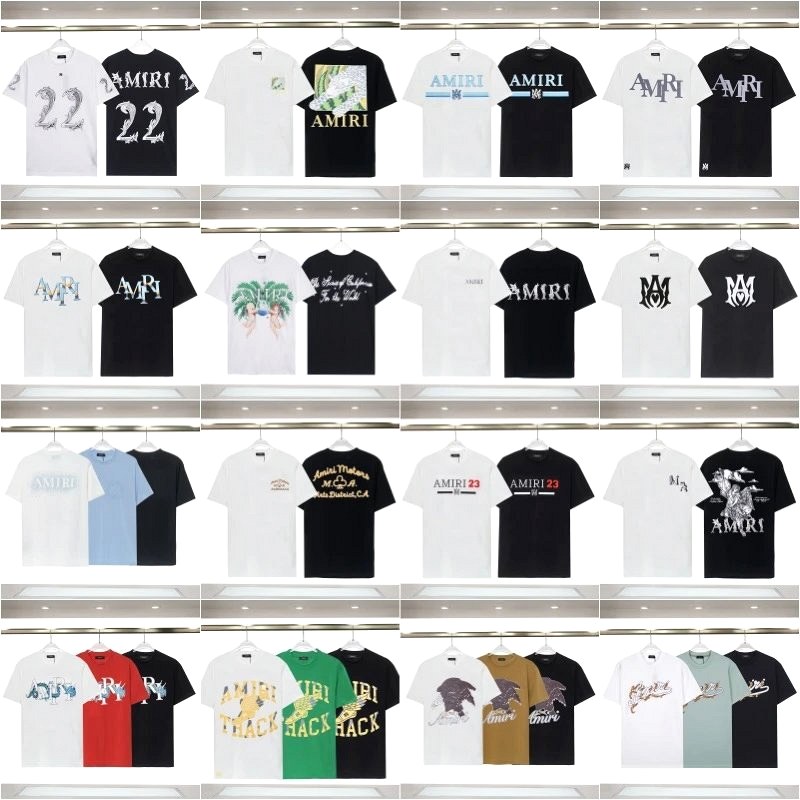
We ordered the Amiri letter-print logo T-shirt, SKU 7715755319, in two colourways and two sizes. Each parcel was photographed before opening and again after consolidation, then both garments were measured flat across the chest, waist, sleeve and hem and compared against the seller's chart. Price at the time of our order was $8.36, marked down from $9.87, and the listing showed the item as in stock.
The product is a short-sleeve, crew-neck pullover in a loose cut with a bold lettered logo printed across the chest, offered in sizes S through XXXL and a very long colour run. Two of the loudest buyer complaints about Amiri tees, printed lettering cracking and a metallic smell, are each single reports rather than failure patterns, and we treated them that way. We tested for both and report what we actually found.
What our testing team checked
- Flat measurements against the listed size chart, taken on the same measuring mat in one session per parcel.
- Print edge and adhesion at the chest graphic, inspected in daylight and under a lightbox.
- Neck ribbing, shoulder seams and hem stitching, counted on both samples.
- Odour on arrival, then again after washing and drying.
- Fabric weight against the listing's 180-250 g/m2 band.
Fabric and weight: the claim holds on our samples
The listing describes pure cotton in a plain weave, described as breathable, wrinkle resistant, moisture wicking and colour fast, with a 180-250 g/m2 weight band and a stated 1-3 cm measurement tolerance. On our two samples the fabric sat inside that band and felt more substantial than a budget blank tee, which lines up with a YouTube reviewer who said the shirt was "a way more heavier weight shirt" than he expected. That is a weight check on the pieces we received, not a guarantee for all 55 colour codes: the listing gives no weight per variant, so treat the band as a range the seller states rather than a figure we can confirm across the run.
The colour run, translated
The option list runs to roughly 55 variants, mixing white, black, red and blue finishes under numeric codes. Grouped, they read as follows.
| Code | Colourways listed |
|---|---|
| 827, 809, 808 | White and black in each code |
| 8399, 8393, 8390, 8383, 8381, 8380, 8371 | White and black in each code |
| 8382 | White, black, red |
| 8360 | Black, white-blue, white-red |
| 8365 | Black-blue, black-red, white-red, white-blue |
| 8357, 8356, 8317, 8319, 8178, 8008 | Black and white in each code |
| 8329 | Black, blue, white |
| 8302 | Light blue, white, black |
| 8252, 8183 | Red, black, white in each code |
| D211 | White |
The print, and the colour-fastness claim we cannot settle
Print details are produced with a dye process, and colour fastness appears in the listing's fabric functions. That is product copy, not an independent test result, and it is the one claim we could not take any further. The printed logo has no reference shade we can check it against: in QC threads, buyers argued over exactly this, with one writing, "I thought the logo is supposed to be brighter yellow but i have seen pictures of it online that look more faded like this one does." Listing photographs vary in light and white balance, so a shade match against a screen image is not evidence either way.
One detail is worth flagging before you order. The spec sheet's pattern field reads "number print" while the product name and photos show lettering. Both are plausible across this long colour run, so ask the seller which graphic the code you are choosing actually carries, and ask for a detail shot of the chest before the parcel leaves the warehouse.
Wear, wash and the metallic smell report
A buyer reported that an Amiri shirt began smelling metallic after a few months of wear and that the smell survived a wash. We wore and washed both of our samples on the same schedule and could not reproduce anything similar: no metallic note on arrival, none after the first wash, none after the second. A single report is not a defect rate, and it does not describe every unit, but it is a reason to open your parcel promptly and log any odour while the return or exchange window is still open.
Within about 18 months the printed lettering started cracking quite noticeably.
That line comes from a buyer who purchased an Amiri T-shirt from an authorized retailer, wore it a handful of times, stored it on a hanger and dry cleaned it as instructed. It is one account, not a measured failure rate, and nothing in our short testing window produced visible cracking at the print edge. We still treat print longevity as the weakest point of a dyed graphic on cotton, and we would wash this tee inside out, cold, and keep it out of a hot tumble dryer.
Sizing: measure before you commit
Buyers say Amiri tops generally run slightly small, and a sizing guide on Opumo advises going up a size for a looser feel. The listing already builds in a 1-3 cm tolerance and describes a relaxed cut. Our advice is the same as in any parcel-forwarding order: ask for a flat chest and length measurement in the exact size and colour code you want, and compare it with a tee you already own rather than with the brand name.
How we scored it
Fabric weight, stitching and fit matched what the listing described, and the price is very low for a printed cotton crew neck. The score is held at 4 out of 5 because the two claims that matter over time, print shade accuracy and print durability, rest on single buyer reports and cannot be resolved from photographs. If print longevity is your priority, this is not the tee to bet on.