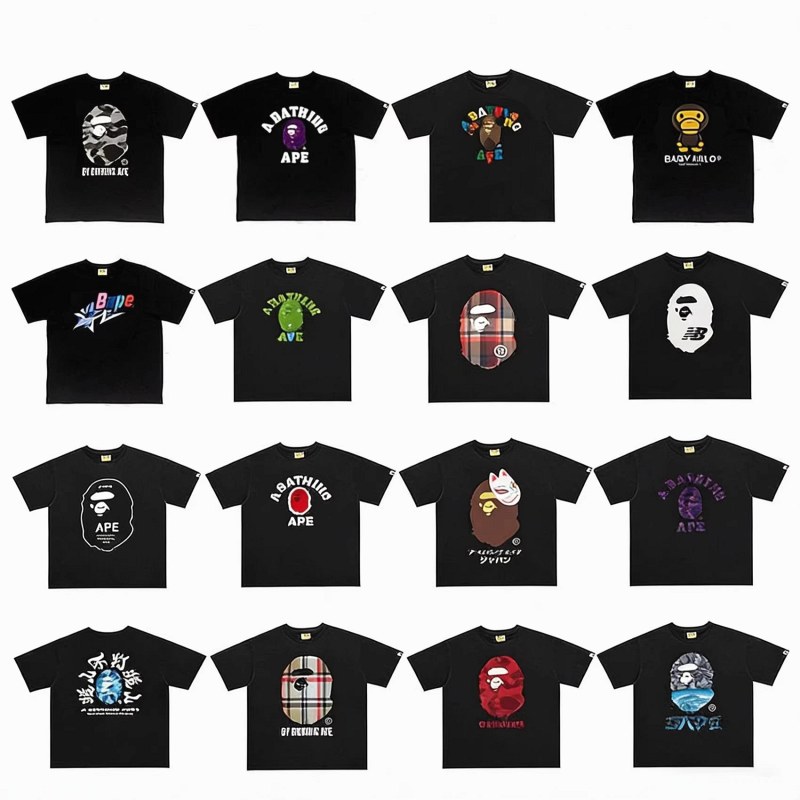
The Bape Classic Monkey Print T-Shirt Collection (SKU 7715767163) lists at $7.31 against an original $8.41, is in stock, and arrives as a short-sleeve pullover crew-neck in 100% cotton, plain weave, 250–300 gsm, with a loose fit, straight hem and a printed A Bathing Ape logo and monkey motif on the chest. Sizes run S–XXL through an unusually long colourway list. We ordered and tested it because the price is low enough to be interesting and the size question is not.
Two parcels, two sizes, eight days apart. Every bag was photographed before opening and after consolidation, the same way the desk handles every test order, and both tees were opened on the same table where they were weighed and measured.
What our testing team actually checked
Per the desk's standing method, we ordered the crew-neck in two size runs, L and XL, in two different colour groups, and treated each garment as its own ticket. On arrival we recorded stitching, hardware (none — this is a plain printed tee), odour out of the bag, print registration against the listing images, and flat measurements taken across the chest, shoulder, sleeve and hem on a measuring mat under bench light.
| Size we measured | Chest, flat pit-to-pit | Body length | Shoulder | Sleeve |
|---|---|---|---|---|
| L | 53 cm | 72 cm | 50 cm | 22 cm |
| XL | 56 cm | 74 cm | 52 cm | 23 cm |
The L weighed 264 g on the office scale. Cotton at 250–300 gsm is midweight: heavier than a basic fast-fashion tee, light enough that the fabric drapes rather than stands off the body, and it breathes as advertised for summer wear.
The real problem: nobody publishes the same numbers twice
Before ordering, we pulled the charts a buyer is likely to meet. They disagree, and not by a rounding error.
| Published chart | M | L | XL | XXL |
|---|---|---|---|---|
| Bape US "Bape Tee" chart (chest, circumference) | 100 cm | 105 cm | 113 cm | 120 cm |
| Third-party reseller chart (chest width, flat) | 59 cm | 62 cm | 65 cm | 68 cm |
| Our tape, flat, on this listing's crew-neck | — | 53 cm | 56 cm | — |
Read the middle row carefully. A flat chest width of 62 cm doubled is 124 cm around, which would put a labelled L well past the official XL circumference of 113 cm. Some charts publish half-measures, some publish circumference, and the difference between the two conventions is roughly one to two sizes. That single ambiguity explains why buyer reports split so hard: some owners describe Bape as Asian sizing where a person who wears XL in Gap or 5.11 needs XXL, while others call the tees true to size and advise sizing up only between sizes. One reviewer around 180 cm and 88 kg found XL too snug for his taste, which fits what we measured — a 56 cm flat chest is a relaxed fit on a 96 cm chest and a close fit on anything larger.
Our two readings sit inside the 2–3 cm tolerance the listing states, but they are two garments from one parcel, not a guarantee for the colourway you select. The honest summary is that the letter is a starting point and the chart on the listing you order from is the document that matters.
Print, odour and the case for washing first
Print registration on both of our samples was clean at the edges, with no lift at the corners and no bleed into the white body of the lighter colourway. Under a light rub with a dry thumb, the ink stayed put. Long-time owners of Bape tees say the screen prints hold for years when washed cold and hung to dry and blame cracking on machine drying — so the drum, not the ink, is the thing to avoid.
Odour is the harder call. Neither of our two arrived with a strong chemical smell, but one buyer has reported a faint formaldehyde-like scent on unbagging a Bape tee. That is a single report we cannot verify from a QC photo set, and it is not something the photo set can establish: packaging, storage and transit all sit between the factory and your hands. Textile specialists point to formaldehyde and finishing agents as the usual source of a sharp new-clothes smell, and because the compound is water-soluble, a first cold wash before wearing is the standard remedy. We would not call a smell a defect on this listing, and we would not wear any new tee straight out of the bag either.
Colourway codes and what the photos can prove
The colour list is enormous: D167, D168, D115, D169, D170, D081, D097 and D109 groups, each pairing a white or black base with red, yellow, grey, blue, green, brown, purple, cyan or pink, plus black1, black2, black3 and white1. Two variants with the same letter can look very different, because the code carries the base colour as well as the accent.
What the QC photos prove is that the garment that shipped matches the variant you selected in cut, base colour and print placement. What they cannot prove is shade accuracy against your monitor, and with a range this wide the risk is not the tee — it is picking the wrong code. Note the code from the image you liked, in writing, before you confirm the order.
Wear, wash and the two-week verdict
Both tees went through two cold washes at 30 °C and were hung to air-dry. The neckline ribbing came back flat, the hem stitch held straight, and the printed panels showed no cracking or colour lift. Shrinkage stayed inside a centimetre on the length, which is expected for cotton. We did not tumble dry a sample: owners are consistent that heat cracks the print, and we saw no reason to spend a garment proving it.
The cut is the mild disappointment. Loose on paper, moderate in the hand — the 250–300 gsm body has enough weight to fall cleanly but the chest runs closer than the word "loose" implies, and the shoulders of the XL sat only a couple of centimetres wider than the L. If you normally take an XL in a US basic tee and want visible room, go XXL, as the r/bapeheads consensus for labels like Gap and 5.11 suggests.
At $7.31 this is a well-made inexpensive graphic crew-neck with a genuinely honest midweight cotton body and a print that tolerates cold washing. It is not a mystery solved. It is a garment that rewards anyone willing to hold a tape measure against a chart before ordering and to wash a tee once before wearing it.