By Priya Raghavan, Reviews Editor
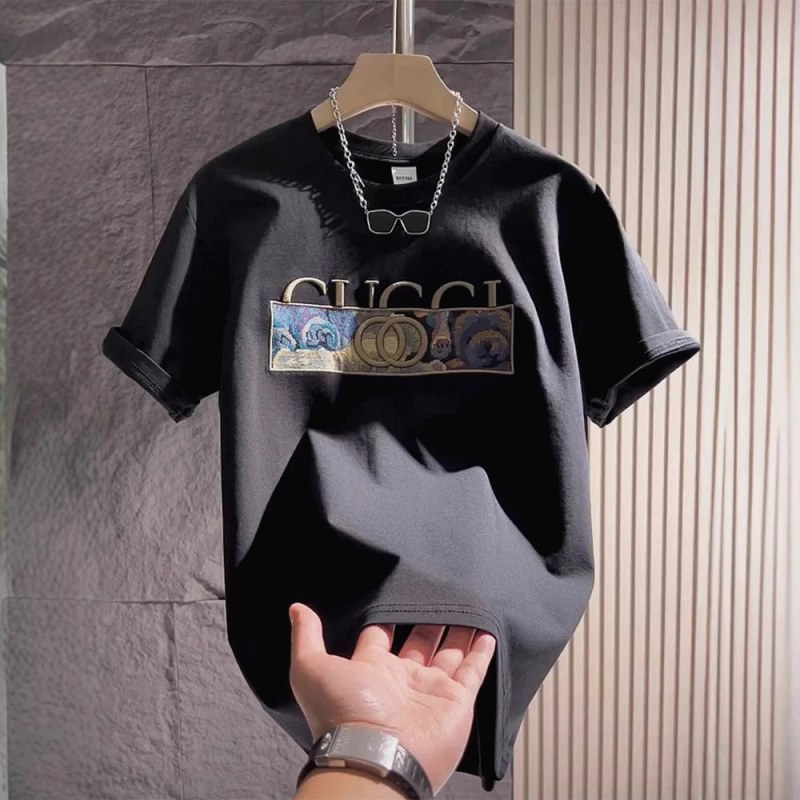
We ordered the Gucci black T-shirt in casual streetwear style as a single unit, logged it on our usual order ticket, and put it on the flat measuring mat the same morning it reached the office. The catalog snapshot for SKU 7715745337 lists cotton as the main fabric, print as the technique, a crew neck, short sleeves, a pullover body described as loose, and a mid-long length band of 65cm to 80cm. Price at the time of ordering: USD 7.31, marked down from a listed USD 8.14, and in stock. Colours on offer are black and white; sizes run S, M, L, XL, XXL and XXXL.
At this price the interesting question is not whether the tee reproduces a luxury garment stitch for stitch. It is whether the warehouse photo set proves enough to accept the parcel, and which parts of the product a buyer can only judge in hand. That is the frame we used.
What the warehouse photos could establish
The pre-shipment QC images are good at gross geometry. From that set we could read whether the collar ring sat round rather than oval, whether the hem line ran level from side to side, whether the chest panel was centred between the shoulder seams, and whether the printed graphic sat on-axis rather than drifting toward one sleeve. We could also see how the print was laid down — a flat, even screen deposit or a heavier, raised one.
That last point is the checkpoint buyers actually use. A fake-versus-real comparison we reviewed notes that printed Gucci lettering on replicas tends to read noticeably thicker than the lettering on an authentic version; that comparison was made on a USD 450 authentic garment against fakes priced at roughly USD 30–80, and our confidence in it is limited, so we treat it as a directional observation about Gucci lettering generally rather than a finding about this shirt.
What photos cannot settle: how the cotton feels, whether the print cracks after washing, whether the body shrinks, and whether the collar relaxes. Those required the garment on the table.
Flat across chest, waist, sleeve and hem
Our standard check is to tape each garment flat across chest, waist, sleeve and hem and compare the readings with the listed chart. Here the comparison has a structural problem: no per-size measurement table accompanied the listing. We had the size ladder but nothing to measure it against, so our tape readings went into the ticket as a record of what arrived rather than as a test of a seller claim. That is a real gap for anyone ordering remotely, and it is the single largest unknown on this product.
| What we checked | How we checked it | What it tells a buyer |
|---|---|---|
| Chest print panel | Squared against the collar seam and shoulder lines | Whether the graphic is centred and printed on-axis |
| Collar ring | Rib width by eye and tape | Whether the neckline sits flat or wants to roll |
| Hem | Levelled side to side | Cut accuracy on a loose silhouette |
| Body length | Taped from high point of shoulder | Where the garment falls inside the 65–80cm band |
| Weight | Flat scale on arrival | The spec sheet lists 0.00 kg, so it supplies no usable mass for freight planning |
| Odour | Recorded within minutes of opening | Whether packing odour needs airing or a wash before wear |
The sizing conflict we could not settle
The listing calls the cut loose, which points to staying at your usual size or sizing down if you dislike volume. Buyer guidance points the other way. A rep-forum thread on Gucci shirt sizing reports that Gucci T-shirts generally run small and that the usual advice for regular, non-oversized Gucci items is to go up once.
Only a few items I know you need to always order double size, but for a regular item like Gucci one size up should be fine.
Those two signals cannot both be right for the same garment, and nothing in the listing resolves it. Our position: trust the tape over the adjective. Ask the seller for chest and length measurements for the size you intend to buy, laid flat, before the parcel ships. If the seller cannot supply them, the honest move is to order one size and accept the fit risk, because the price is low enough that a second parcel is not ruinous — but a wrong fit is still a wrong fit.
Where the design work actually sits
The neckline, sleeve length and hem are plain. One wide printed panel across the chest carries the entire visual argument, with lettering and interlocking detail doing the work. That makes placement the whole product: if the panel sits low, the graphic fights a jacket collar; if it sits high, it crowds the neckline. It also means the tee reads best as a layer rather than as a statement piece — under an open jacket and over denim or shorts, so the print stays visible without the rest of the outfit competing.
The catalog lists this as a 2025 summer release with a casual, gender-neutral, Japanese/Korean casual direction. The styling is neutral enough to support that, and the black colourway is the quieter of the two on offer.
What we would tell a buyer at the counter
Judge this tee on two things: the photo set that covers centring and print relief, and a measurement answer from the seller before shipping. Everything else — hand feel, wash behaviour, long-term collar shape — is a post-arrival question. At USD 7.31 the downside is small, but so is the evidence base, and the size chart that would have closed the gap is still missing.