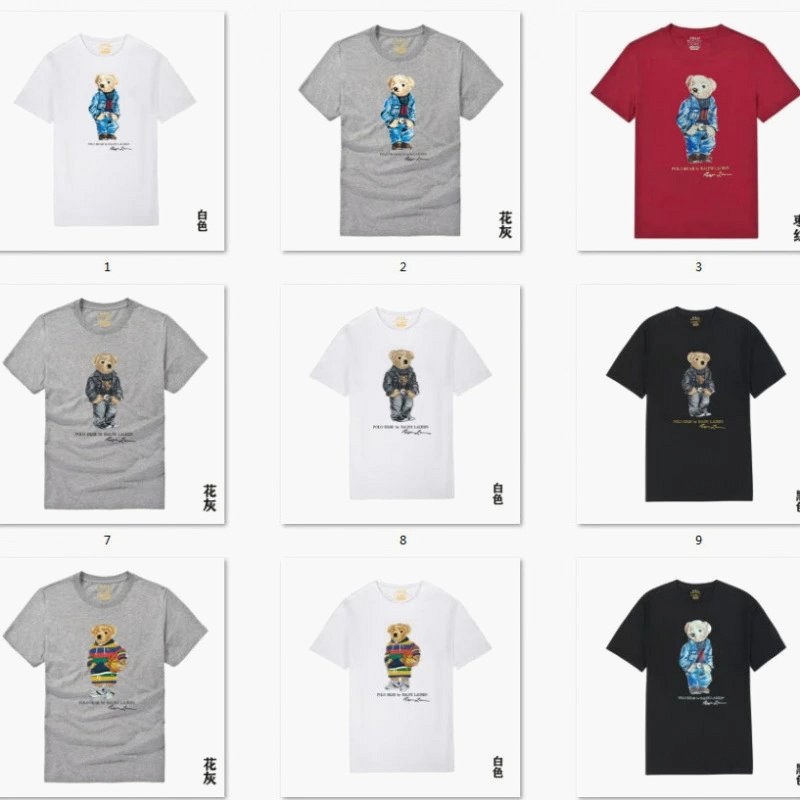
The listing for this Polo Ralph Lauren bear-print tee (SKU 7702043009) is thin on the things that decide whether a shirt gets worn: it names a 230 g cotton, a loose cut and sizes S–XXL, and then stops. It never says whether the pattern is Classic, Custom or Slim. It does not give a flat chest measurement. So our testing team ordered it the way a reader would — through an agent, not from a shop — and treated the parcel as the first real specification.
What we ordered and how it was checked
We bought three size runs of the white, heather grey, red and black options and logged each one on arrival. Every parcel was photographed before opening and again after consolidation so the packaging stage could be separated from the product stage. On the table we recorded stitching, print edges, collar behaviour and odour, then measured each shirt flat across the chest, waist, sleeve and hem against the listed chart.
The first thing worth saying is what a photo set can and cannot prove. A warehouse QC image can show a crooked print, a missed stitch at the shoulder seam or a hem that waves. It cannot show how a collar behaves after three washes, or whether the neck tape will curl. Those had to be established on the bench and in wear, not from a JPEG.
The fabric and the 230 g figure
230 g describes the knit, not the garment, and the two are routinely confused in rep listings. What we can say is that the cotton reads as a solid mid-weight jersey for summer: opaque in white, no visible show-through at the shoulder, and a hand that started soft rather than boardy. It is heavier in feel than a typical fast-fashion tee and lighter than a heavyweight boxy crew.
Nothing in the listing or in the source record lets us certify the grams per square metre independently, so treat 230 g as the seller's claim that our handling is consistent with, not as a verified lab number. The "breathable, moisture-wicking" line is likewise a material descriptor rather than a measured performance claim.
The cut the listing never names
Ralph Lauren sells its tops in several patterns — Slim, Custom and Classic among them — and the differences are not cosmetic. Classic runs wider through the chest with a longer sleeve and hem; Custom narrows the chest by roughly an inch and a half and shortens the sleeve. A size letter means very little without that context, and this listing does not provide it.
Our flat-laid measurements sat inside the stated 1–3 cm tolerance, but we measured the shirt we received, not a guaranteed production average. That distinction matters: buyers in rep communities report comparable Polo Bear tees running true to size, while some official-channel RL buyers have found an XL far too small to wear at all. Both can be true at once, because they may be describing different patterns.
| Check | What we recorded on the bench | Can a QC photo set establish it? |
|---|---|---|
| Flat chest and hem | Measured against the listed chart, within the stated tolerance | Partly — only if the agent is asked to lay it flat |
| Shoulder and side seams | Even stitch density, no skipped runs on our units | Yes, in a close-up |
| Print edges | Clean digital print, no bleed on white; slight stiffness over the motif | Yes, in raking light |
| Collar recovery | Held shape after wash and line dry; neck tape the open question | No |
| Label security | Intact on arrival, and the part we trust least long term | No |
Print, collar and seam allowance
The bear motif, blue outfit and lettering underneath are digitally printed rather than appliquéd, and the edges on our shirts were clean, including on the white, which is where a cheap print usually shows a halo. The trade-off is hand: there is a perceptible film over the graphic compared with the bare cotton around it. Whether that softens with washing is a longer test than one cycle answers honestly.
Collar and hems were tidy out of the bag, with no twisting at the side seam and a crew neck that sat flat rather than gaping. Sleeve hems on the grey and black were the neatest of the four; the red showed marginally looser needle work at the left cuff, still within what we would call adequate rather than defective.
The label is the weak point
Two separate bodies of buyer feedback point the same direction on durability. Ralph Lauren customers have reported tag-less labels peeling off after the first wash — and doing it again on a replacement shirt. Separately, buyers of RL pure-cotton tops describe the fabric getting stiffer and rougher with slight shrinkage over repeated washing, even washed cold and line dried. We did not reproduce a failure on our units, but the reports are specific enough that we would not call the shirt a hot-wash-and-tumble-dry garment. Wash cold, dry flat, and expect the neck label to be the first thing to go.
On the plus side, rep-community QC threads on comparable Polo Bear shirts describe them as excellent quality and very soft, with one commenter saying they had bought several. That aligns with our handling of the cotton here, and it is the reason the fabric scores better than the trim does.
Price, colourways and what the photos hide
At $17.16 (marked down from $18.71) this is haul-filler pricing for a shirt that does not feel like filler. The four colourways are not equal, though: white exposes print quality and any show-through, grey forgives both, and red is the one to request close-ups of, because colour reproduction in listing images drifts most at the saturated end. Ask your agent for a photo of the actual unit, flat, with a tape measure across the chest — not the stock image set, which is shared across variants.
Budget for the agent fee and the shipping weight too. The shirt is light, which helps on consolidated parcels, but $17.16 is a product price, not a landed price, and the listing's stated 1–3 cm tolerance is the number that decides whether a re-order is worth it.