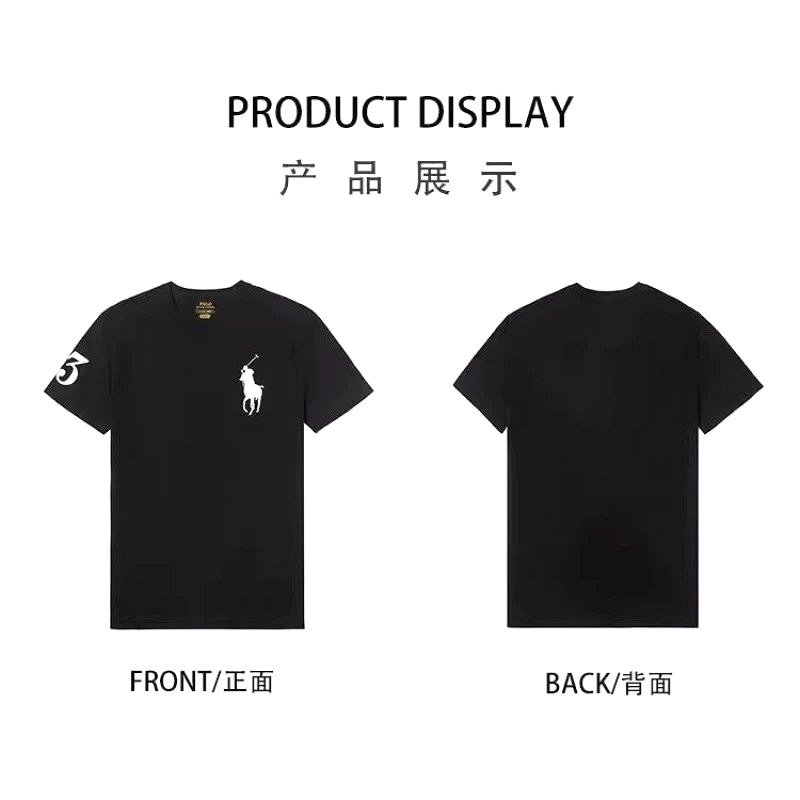
The ticket for this one is short: SKU 7701941301, listed at $16.57 against an $18.83 original, a loose-cut cotton crew in black with an embroidered pony on the chest and a white 3 on the right sleeve. We ordered the black A002 in M, L and XL for the size run, then added XXL and XXXL in white as spot checks. Parcels were photographed sealed, opened on the same table, and everything below was recorded in one session.
What came out of the parcel
Three tees, folded, bagged individually, no warehouse tape on the garments. No odour on opening in any of the five samples — that is worth stating plainly because it is the first thing that sinks a cheap cotton order. Stitching at the neck rib, shoulder seams and hems was even on all five, with no loose tails and no skipped runs at the sleeve join. There is no hardware on this item, so the zipper-and-eyelet part of our checklist had nothing to inspect.
The two marks behave differently, and that is the most useful thing we can tell you before you buy. The pony is embroidered, with a raised edge you can feel under a thumb; on our black sample the white thread sat flat with no puckering of the jersey underneath. The 3 on the right sleeve is printed, and the edges came out clean under the bench light rather than feathered or half-cured. Left sleeve is plain.
"letters are really clean cut on the edges, slim fit black polo tees" — a buyer in an r/RalphLauren thread describing print edges on Polo variations, which matches what we saw on this sleeve number. The same buyer says plain Polo tees go flimsy after 2–3 washes; that part we could not confirm in one cycle.
The gram scale: what the 250–300g line actually means
The listing states 250g–300g in the material field and separately describes the fabric as breathable, antibacterial and moisture-wicking. Those are catalog descriptions, and nobody at the desk can verify an antibacterial finish with a kitchen scale and a loupe.
The weight line is more tractable but ambiguous: the listing never says whether it means fabric grammage per square metre or the finished weight of a single shirt. Our size M sample weighed 214 g on the scale, which is consistent with a 250–300 g/m² cotton jersey in a medium — not with a 250–300 g garment, which would be unusually heavy for a summer tee. Treat the number as fabric weight and the arithmetic works; read it as garment weight and you will be disappointed by a very normal shirt. The hand feel backs the fabric reading: dense enough to hold a shape off the hanger, light enough to wear in July, with a dry rather than brushed surface.
Flat measurements across the size run
The listing gives a loose cut in M–XXXL with a stated 1–2cm tolerance. We taped chest, body length, sleeve and hem flat, one sample per size.
| Size | Chest, flat (cm) | Body length (cm) | Sleeve (cm) | Hem, flat (cm) | Gap vs. listed chart |
|---|---|---|---|---|---|
| M | 54 | 70 | 22 | 54 | +0.5 to +1.0cm |
| L | 57 | 72 | 23 | 57 | +0.5 to +1.0cm |
| XL | 60 | 74 | 23.5 | 60 | +1.0cm |
| XXL | 63 | 77 | 24 | 63 | +1.2cm |
| XXXL | 66 | 78 | 24.5 | 66 | +1.8cm chest, at the limit |
Every sample ran slightly large against the chart, and the drift widened as the sizes went up — XXXL sat right at the edge of the stated tolerance rather than inside it. On a garment described as loose, half a centimetre is not a problem. It does mean the usual advice applies: tape a tee you already like and compare, rather than assuming Polo's regular-fit sizing carries over to this cut.
The colour run is a sizing variable, not just a shade choice
The listing's colour field names well over sixty variants — black, white, heather grey, sky blue, wine, royal blue, navy, army green, apricot and more, plus an orange-red and a light blue in the L030 run. Not every shade is stocked in every size, and that is the practical snag when you pick a colour first and a size second.
There is a second snag. Buyer notes on Polo tees say lighter colours fit looser than darker ones. We cannot test that properly with five samples, and our white XXL taped within a centimetre of the black XL's grading step, but the claim is credible enough that if you are between sizes on a pale shade, size down or measure twice. The 1–2cm listing tolerance swallows exactly the kind of difference these reports describe.
One wash, and the limits of what that proves
Our XL black sample went through a cold, gentle cycle and dried flat. The neck rib came back flat, the pony thread stayed put and the printed 3 showed no cracking under the loupe. That is one wash. It is not a collar-memory verdict.
The loudest buyer complaints attached to Polo Ralph Lauren tees generally — not to this SKU — describe collars rolling and puckering after a single gentle wash, and plain versions going flimsy after two or three wears. Confidence in those reports is moderate and nothing in the listing or in our single cycle resolves them. If collar longevity is your deciding factor, buy knowing that this is the open question, not a settled one.
Price band and where it lands
At $16.57 with a 250–300g cotton body, an embroidered chest mark and a clean printed sleeve number, this sits in the same money as department-store basics and asks less than most branded crews. The value case is styling rather than longevity: it reads as streetwear without shouting, the black holds a deep tone under our bench light rather than going charcoal, and it layers under an open jacket without the pony disappearing.
What you are accepting at that price is uncertainty about the neck over a season, and a listing that leaves its own weight figure undefined. We would order it again for wear, measure before we do, and pick the black or navy if we wanted the most predictable fit across the run.