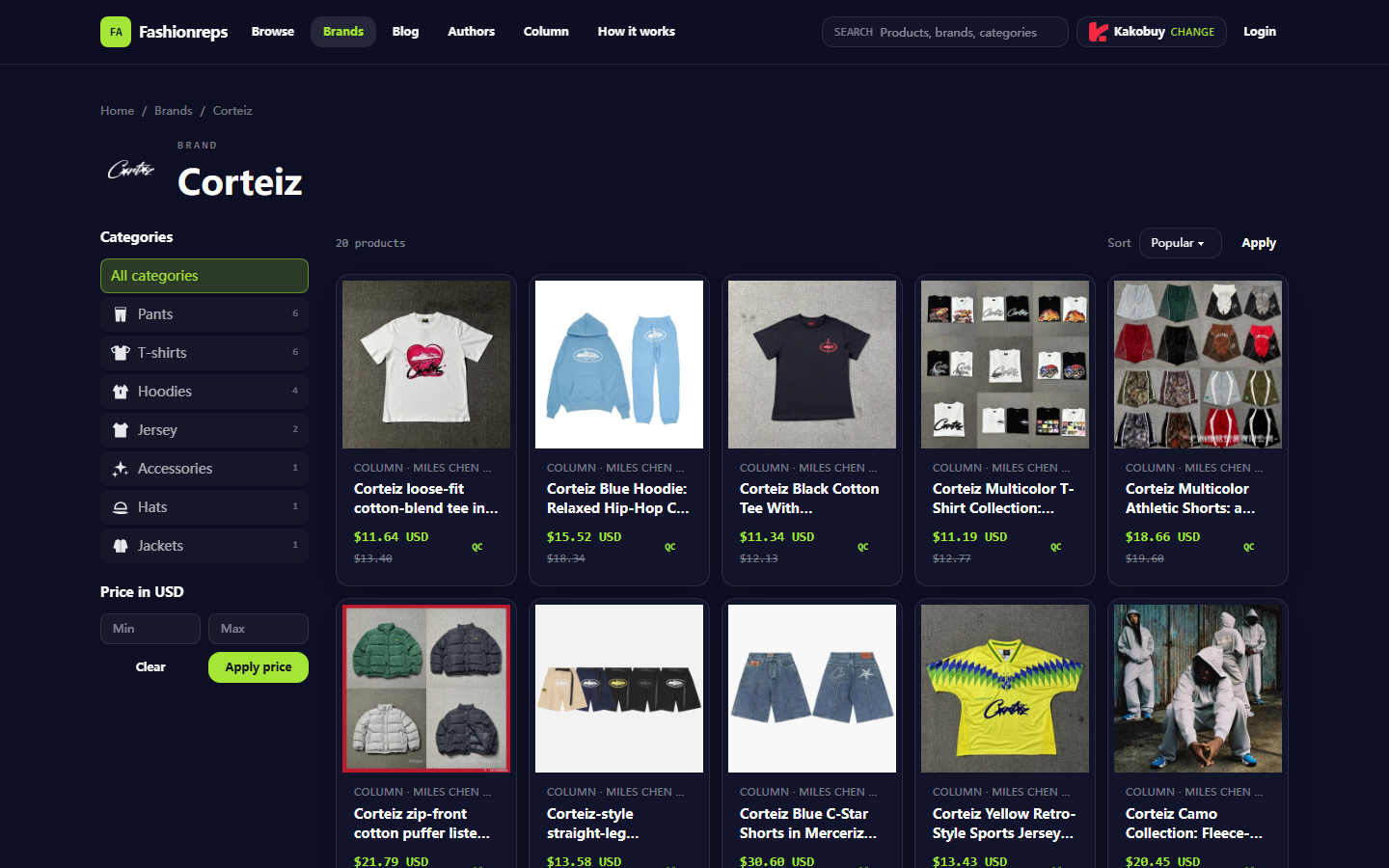

Image caption: The Corteiz brand page on fashionreps can serve as a starting point, but you still need to verify each item's product page, QC photos, and agent warehouse information before ordering.
The Layering Task for This Review
This review addresses one question: if you plan to wear a Corteiz tee as an inner layer under a hoodie, jacket, or shirt, how should you use the fashionreps page, product photos, and subsequent QC photos to decide whether it's worth proceeding before adding it to your cart or submitting an order?
It's not meant for authenticating items, nor is it a replacement for size charts, physical measurements, or agent warehouse inspections. For tees, a low price doesn't mean low risk, because misaligned prints, loose collars, thin fabric, color fading after washing, and shrinkage become more noticeable when layered. 🙂
This page was last checked on 2026-10-08. The fashionreps Corteiz brand page shows several Corteiz-related tee candidates, including a white digital art print tee, a black embroidered letter tee, multi-color 250g cotton-blend tees, multi-color 240g relaxed crewneck tees, and a 3D printed letter relaxed crewneck tee. The page displays reference prices, titles, categories, and platform redirect links; actual stock, final prices, size options, seller status, shipping, taxes, and after-sales terms still need to be confirmed on the agent's site or original product page.
Verifying Corteiz Tee Page Information on fashionreps
Don't be swayed by terms like "loose," "boxy," "250g," or "3D print" in a single product title. They're filtering clues, not verification conclusions. A safer approach is to treat fashionreps as a discovery and initial screening tool, then verify the orderable status on the purchasing agent's page.
Follow this sequence:
- First confirm it's actually in the T-shirts category, not a short-sleeve jersey, hoodie, or a top from a set.
- Note the material, weight, fit, size range, and print technique described in the product title.
- Check the reference price and previous reference price, but don't treat them as the final payment amount.
- After clicking the purchase link, confirm on the agent's page whether the item is still available, colors and sizes are selectable, and there are any seller remarks.
- After ordering, wait for warehouse QC photos, then use the actual images to decide whether to ship, request more photos, exchange/return, or cancel.
You can organize the available candidate information into a simple table to avoid mixing up different styles:
| Candidate Style Clues | Visible Page Information | Key Checks Before Layering |
|---|---|---|
| White digital art print tee | White, 250 gsm, cotton-blend, reference price ~$11.64 | Sheerness on white, front graphic position, print edges |
| Black embroidered letter tee | Black, embroidered letters, boxy streetwear cut, reference price ~$11.34 | Embroidery puckering, collar shape, overly wide shoulders |
| Multi-color 240g or 250g tee collection | Multiple colors, multiple prints, XS–XXL or similar size range | Color differences, same fit across colors, consistent size charts |
| 3D printed letter relaxed crewneck tee | Relaxed crewneck, S–3XL, reference price ~$4.93 | Print durability on low-priced item, fabric thickness, hem twisting |
This table only indicates "what's worth checking further," not which one is best. Especially for multi-color collection items, different colors and prints may not be from the same batch, so you can't rely on a single main image to vouch for all options.
Visible Checks for Print Position, Edges, and Color Differences
Common risks with Corteiz-style tees aren't just about whether the graphic looks good, but whether it appears crooked, too low, dirty, or cheap when worn. When layering, only parts of the collar, chest, and hem are visible, so slight misalignment becomes more noticeable.
At the product image stage, look for three things:
- Is the front graphic near the center line, with roughly equal margins on both sides?
- Are the print edges clearly rough, showing white edges, ghosting, or jaggedness?
- Are light prints on dark fabric clean, and dark prints on light fabric free of bleeding?
But product images are usually curated; the real deciding factor is the QC photos. When you receive warehouse photos, ask for at least front flat lay, back flat lay, collar label or care label, and a close-up of the print. If the agent's default QC photos are too far away and you can't see print edges or color differences clearly, don't rush to consolidate shipping. 📸
A conservative judgment: a slight 0.5–1 cm offset may not be noticeable when worn; but if the center line is off, chest height is abnormal, or sleeve hems show asymmetric, it will be hard to hide with an outer layer. For large areas of thick or rubberized prints, also check if the graphic area appears shiny, bubbled, or has a stiff edge.
How Collar, Shoulder Seams, and Hem Affect Layering
When using a tee as an inner layer, the collar matters more than the overall "hype" of the garment. A crewneck that's too wide will collapse in a ring under a hoodie or jacket; too tight may choke or create unnatural wrinkles.
Look at these in QC photos:
- Is the collar ribbing even, with consistent curvature on both sides?
- Do the shoulder seams drop excessively? If you want a clean inner layer, too much drop shoulder will cause your outer layer's shoulders to bunch up.
- Is the hem level? Are the side seams twisted?
- Will the sleeve length create an awkward proportion when peeking out from a short-sleeve shirt or light jacket?
If the product title says loose, boxy, or oversized, don't just buy your usual size. A safer method is to take a tee you commonly wear as an inner layer, measure its shoulder width, chest width, and length flat, then compare with the seller's size chart and QC measurements. Relying only on height and weight recommendations often leads to a tee that's fine alone but too thick for layering. 😅
Conservative Assessment of Washing and Color Fading Risks
Washing risks can't be proven from product images. Seeing "cotton-blend," "240g," "250g," "digital art print," "3D print," or "embroidered lettering" in the page title only tells you what to inspect, not that it will withstand washing.
Conservative pre-purchase checks include:
- Dark tees with large prints need a separate first wash in cold water, inside out.
- Areas with rubberized or thick prints should not be machine dried at high heat or ironed directly.
- If a white tee is thin, it may show the inner layer's color or print silhouette when layered.
- For embroidered items, check the backside for loose threads or puckering that could irritate skin.
Don't claim "won't fade" or "won't deform after washing." Without long-term washing records, physical photos, and clear conditions, only risk-control suggestions can be given. A practical approach: take photos before the first wash, wash separately, use low spin, and air dry; if there's noticeable fading, adhesive failure, or shrinkage, use the photos and order records to discuss after-sales with the agent or seller.
Keep QC Photos Separate from Product Images
Product images help you shortlist; QC photos help you decide whether to ship. They serve different purposes. If product images look good but QC photos show a crooked print, trust the QC photos; if QC photos are unclear, don't use product images to fill in the gaps.
Keep a brief record:
- Product page screenshot: title, color, size, reference price, purchase link, and date checked.
- Agent order screenshot: options, payment amount, seller remarks, and order status.
- QC photos: front, back, collar, care label, print close-up, and size measurements.
- Decision: pass, request more photos, change size, exchange/return, or cancel.
Redact private information like name, address, phone number, order number, and payment details. Redaction must not cover the item itself, size data, or shipping status. The value isn't to "look professional," but to have a clear evidence trail when you need to request more photos, change items, or file a claim.
Community Feedback as a Source of Checkpoints
Community discussions can help you spot common issues, like a certain print cracking easily, a particular color being thin, or certain sizes running short. But they can't replace the current product page and your QC photos. Different sellers, batches, and agent warehouse lighting will yield different results.
Use community feedback only as a checklist source:
- If many mention a loose collar, zoom in on the collar in QC photos.
- If someone notes prints sitting low, request a flat front photo and check chest position.
- If discussions focus on shrinkage, compare length and chest width more strictly before ordering.
- If comments are highly polarized, don't take the top-voted reply as the conclusion.
Don't fabricate user reviews or turn scattered comments into "widely accepted best." For these tees, the most reliable path remains page information, agent availability, QC photos, and your own sizing needs. 🔎
Final Action: Request More Photos, Switch Items, or Keep as Candidate
After reviewing the page and QC, decide using these rules:
- Keep as candidate: print position is normal, collar is neat, shoulder width and length fit your layering needs, and the item is still purchasable.
- Request more photos: print edges, collar, care label, or measurements are unclear, but no major flaws are evident.
- Switch item or color: within the same collection, one color has high print risks, while another has clearer information.
- Exchange/return or cancel: print is clearly misaligned, collar is deformed, hem is twisted, or size measurements deviate beyond your acceptable range.
If your goal is to save money, the advantage of low-priced Corteiz tees is mainly low per-unit cost, suitable for comparing several options at the candidate stage; the risks are unclear QC, uncertain print durability, and significant batch-to-batch size differences. They suit people willing to wait for QC, okay with back-and-forth for more photos, and using them as daily inner layers. Not recommended for those who need items quickly, can't accept minor flaws, or require consistent bulk purchases of the same style. ✅
The conclusion is simple: when looking at Corteiz tees on fashionreps, treat them as verifiable candidates, not confirmed gems. First check if the page is still buyable, then examine print, collar, shoulder seams, hem, and wash risks; if QC photos are insufficient, request more before consolidating. This may not guarantee a perfect tee, but it significantly reduces the chance of "realizing it can't be layered after it arrives." 👕