
Verification date: 2026-10-07
Applicable platform: fashionreps product discovery page; subsequent ordering, payment, warehouse inspection, and international shipping are completed by your chosen shopping agent.
What This Post Helps You Decide
This post only helps you decide whether a Patagonia jacket candidate is worth entering the agent ordering process, focusing on smart-casual layering, size evidence, and QC risks. It does not authenticate items, promise seller shipping reliability, or treat page reference prices as final landed costs.
If your goal is to buy a jacket for urban commuting, light outdoor use, and autumn/winter layering, after reading you should be able to do four things:
- Determine whether the product page info is sufficient to support ordering.
- Estimate whether it suits layering over hoodies, knits, or light liners.
- Know which areas to check when warehouse QC photos arrive.
- Choose among saving, requesting additional photos, or dropping the candidate.
Also clarify inapplicable situations first: if you need official warranty, confirmed authentic channels, professional alpine gear, or verified waterproof/breathable specs, such fashionreps candidates should not be your only basis. 🧭
First, Confirm the Patagonia Jacket Info on the fashionreps Product Page
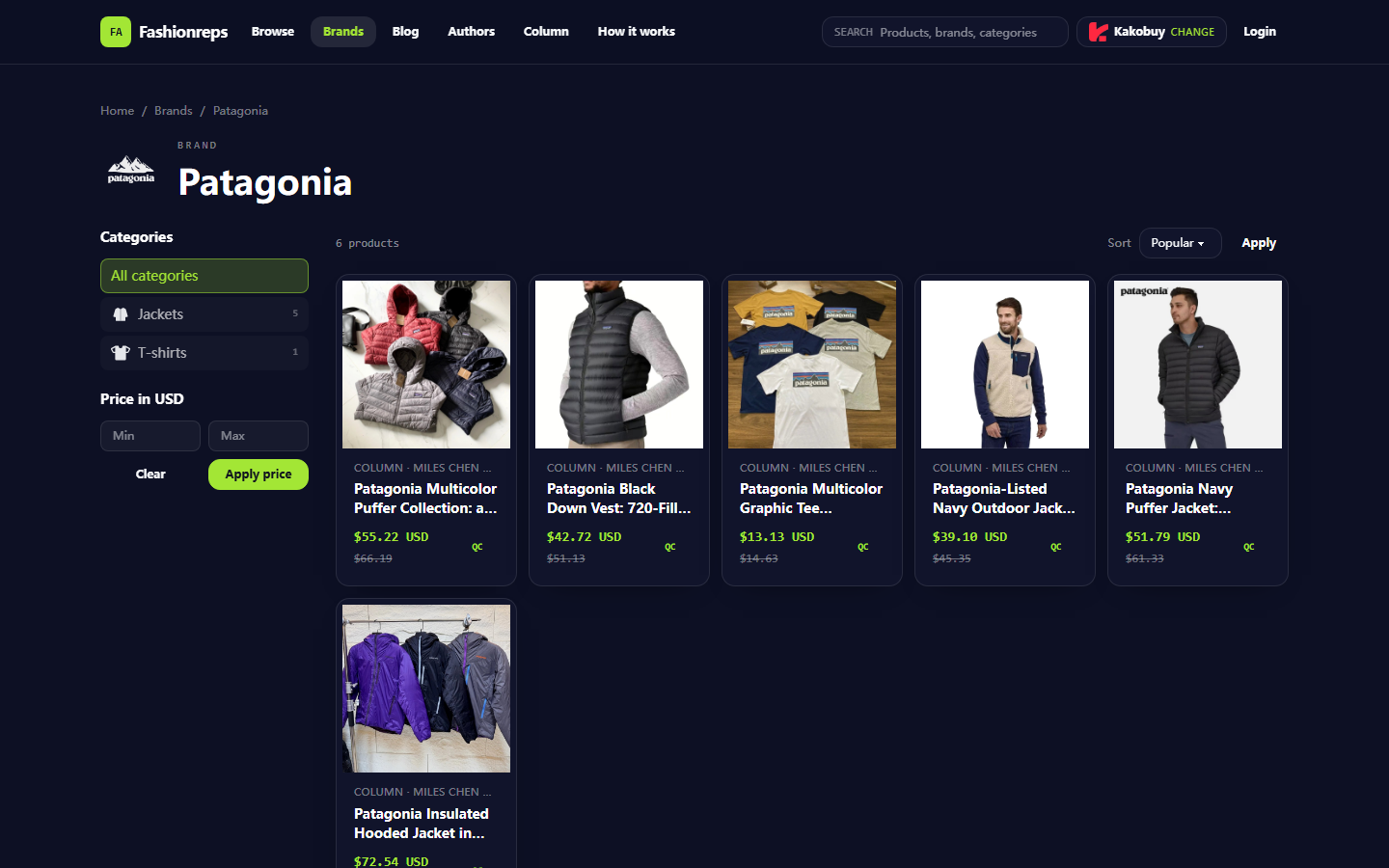
Based on the current visible page sample, fashionreps' Patagonia brand page displays 6 products, with 5 in Jackets and 1 in T-shirts. Visible jacket/outerwear candidates include down jackets, down vests, fleece fabric outerwear, hoodless down jackets, and synthetic-filled hooded jackets. The page shows reference prices, title summaries, brand page filters, and switchable shopping agent entry points.
This indicates fashionreps is more of a product discovery and shopping guide entry rather than a platform that completes orders directly. The Buy button on the page will redirect to your chosen shopping agent, and orders, payments, warehouse inspection, international logistics, and after-sales must be continued on the agent side. Don't just look at words like Patagonia, fill power, or outdoor in the title—treat them as clues to verify.
The visible Patagonia jacket candidates on this page can be organized as:
| Candidate Type | Page Visible Clues | Main Risks Before Ordering |
|---|---|---|
| Hooded 550-fill white duck down jacket | Multiple colors, hooded, reference price about $55.22 | Fill power, down distribution, hood shape, and fabric feel need QC verification |
| Black 720-fill sleeveless vest | Nylon layer, five colors, reference price about $42.72 | Shoulder width, underarm opening, and compatibility with inner layers can easily go wrong |
| Fleece fabric stand-collar jacket | Navy, fleece surface, down fill, reference price about $39.10 | Material description combination is complex; need to confirm if actual item matches title |
| Hoodless 800-fill down jacket | Navy, slim fit, reference price about $51.79 | Slim fit has less layering allowance, risky if size evidence is insufficient |
| Blue synthetic-filled hooded jacket | Lightweight synthetic belay style, reference price about $72.54 | Cut, sleeve length, fill thickness, and color deviation need QC photos |
These prices should only be understood as page reference prices, excluding agent service fees, domestic shipping, international shipping, possible volumetric weight, customs duties, or after-sales costs. 💸
Fit and Sizing: Determining Layering Possibility from Page Data
When reviewing a Patagonia jacket, don't first ask "does it look good?" but "can I wear the layer I actually would wear underneath?" Smart-casual layering usually has three scenarios: T-shirt plus jacket, hoodie plus jacket, light down or fleece plus shell. If the page only gives generic S/M/L/XL without chest, length, shoulder, sleeve measurements, it's not advisable to order directly.
For jackets, at minimum find these evidences:
- Chest or half-chest: determines if hoodies, sweaters can fit inside.
- Length: determines if it covers hips during commute or rides up when biking.
- Shoulder width or raglan sleeve description: determines if it looks tight.
- Sleeve length: determines if cuffs are noticeably short when raising arms or wearing a backpack.
- Model height/weight or real fit photos: only as reference, cannot replace flat measurements.
If it's the slim-fit hoodless down jacket mentioned on the page, size more conservatively. Slim fit's advantage is clean and sharp, suitable for office, subway, and light commuting; disadvantage is that with a thick hoodie inside, chest may bulge, armholes bind, and hem stretches. If you often wear hoodies over 300g in winter, prioritize chest allowance rather than blindly choosing your usual outerwear size.
If it's a hooded or belay style synthetic-filled jacket, it's usually more suitable as an outer layer, but still check hem length and hood volume. An overly large hood will push against backpack straps in commuting, and an overly soft brim blocks vision. Page title saying lightweight does not mean thin or light; ultimately rely on agent warehouse weighing, size chart, and real photos of thickness.
Design Details: How to Check Zippers, Pockets, Collar, and Hem
The practical feel of Patagonia-style outerwear often comes from small details, but details are also where reps, different batches of the same model, or seller photos most easily go wrong. Before ordering, look at the product page; after warehouse arrival, look at QC photos—focus differs.
At product page stage check four things:
- Zipper: main zipper straight, puller position clear, placket not obviously skewed.
- Pockets: number and position of chest, hand, inner pockets consistent with title description.
- Collar: stand collar can block wind, hooded models have adjustment structure at hood opening.
- Hem: has drawcord, elastic edge, or obvious cinching, determines if layering looks bulky.
At QC stage be more specific: lay flat front to see zipper waviness, side or angle to see fill clumping, back to see shoulder line symmetry, close-ups to see embroidery, woven labels, hang tags, and care labels clearly. Don't ask agent to judge authenticity; more realistic request is additional photos of "neck label close-up, care label close-up, zipper puller close-up, cuff and hem close-up, front and back in natural light." 🔍
Image Evidence: What to Look for in Main, Detail, and QC Photos
Main photos solve first impressions, detail photos solve whether seller gave enough info, QC photos solve whether the actual item you receive is acceptable. Don't conflate the three.
Main photos can show color, silhouette, and styling direction, but not suitable for judging fabric hand feel, thickness, or workmanship consistency. If detail photos only show logo and partial view, not front/back, cuffs, collar, hem, and lining, evidence is incomplete. After QC photos arrive, compare page promises to actual item item by item, not just ask "does it look okay?"
Recommended QC check order upon receipt:
- Front overall: color, cut, zipper, pocket positions obviously abnormal?
- Back overall: shoulder line, fill distribution, length visual coordination?
- Collar and hood: collapsed, skewed, overly puffy, or unnatural shape?
- Cuffs and hem: elasticity, stitching, drawcord, edges symmetric?
- Labels and care tags: clear info, any conflict with page description?
- Weight and measurement: weight matches expectations, key dimensions close to seller size chart?
If QC photos are only distant, dimly lit, without measuring tape, better request additional photos first. Additional photo cost is usually lower than international return and idle cost. 🙂
Suitable Scenarios and Not-Suitable Groups
These Patagonia jacket candidates are more suitable for those who understand agent shopping process, are willing to wait for warehouse QC, and can accept additional photo communication. Suitable scenarios are daily commuting, campus styling, light warmth, weekend city outings, and as an outerwear with outdoor-like style but no professional gear responsibility.
More suitable for:
- Want commute outer layer, don't pursue official after-sales.
- Willing to use QC photos to filter out obvious flawed items.
- Already know your outerwear chest, length, sleeve preferences.
- Can accept color, fill thickness, or local workmanship batch differences.
Not recommended for:
- Need confirmed authentic, official invoice, or warranty.
- Plan to use in professional environments like intense mountaineering, skiing, long-distance trekking.
- Cannot accept international shipping wait, return/exchange costs, and agent communication costs.
- Very sensitive to logo, labels, color accuracy.
Simply put, it's more like a style candidate requiring evidence screening, not a no-brainer functional gear. 🧥
Pre-Purchase Checklist
Before ordering, save the candidate to favorites, then confirm item by item. If any item affects your usage scenario and lacks evidence support, don't rush to pay.
- Product page opens, title, main image, price, specs clear.
- Size chart exists with chest, length, sleeve, etc.
- Your inner layer thickness converted to needed chest allowance.
- Page images cover front, back, details, and lining.
- Reference price is only product price, not including domestic shipping, international shipping, taxes.
- Selected agent supports the product link, warehouse QC, additional photos, after-sales communication.
- Prepared to decide ship, exchange, or give up after receiving QC.
- Destination country has no import restrictions, declaration documents, or extra tax requirements.
Customs clearance and declaration must be handled truthfully according to destination country requirements. Don't request under-declaration, split shipments to evade inspection, or fill untrue product names to save money; this increases risk of seizure, fines, and after-sales failure.
Final Action: Save, Request Additional Photos, or Drop Candidate
If product page has complete size chart, sufficient images, price within acceptable risk range, and you're willing to wait for QC, then saving and entering agent ordering process is reasonable. Don't consolidate and ship all at once; wait for warehouse photos to confirm size, color, zipper, pockets, collar, and hem.
If page info is basically usable but lacks key measurements or detail photos, next step is additional photo request or agent note checkpoints. Especially for slim down jackets and synthetic-filled hooded jackets, additional photos of chest tape, length tape, zipper puller, neck label, care label are cheaper than finding out after arrival that layering doesn't work.
If page only has blurry images, no size data, contradictory title descriptions, or you need official-level performance and after-sales, simply dropping the candidate saves trouble. What you save is not just a few dollars but international shipping, return communication, and idle costs.
Conclusion: The current visible fashionreps Patagonia page provides multiple outerwear candidates and reference price clues, but the real buying decision still rests on size evidence, QC photos, and agent process. Suitable for those willing to use evidence to screen a smart-casual layering outerwear; not suitable for those wanting one click to get confirmed authenticity, confirmed performance, and confirmed after-sales. ✅