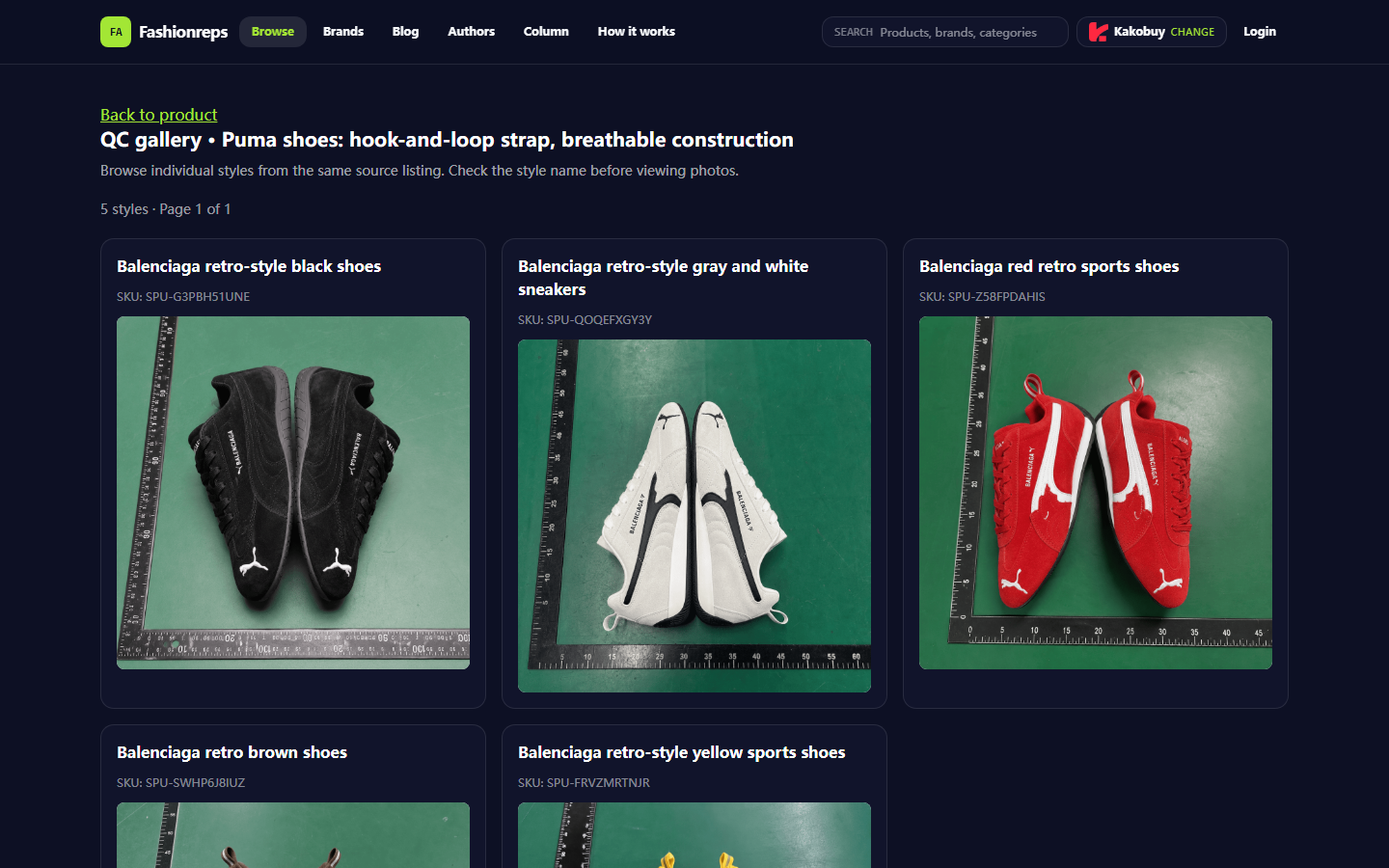
If you're planning to buy a pair of Puma shoes for indoor training, the first thing to confirm isn't the colorway or brand name—it's whether the product page and QC photos provide enough stability clues. This article focuses on pre-order checks: examining the outsole platform, heel structure, upper lockdown, sizing info, and visible images, while distinguishing what can be observed from what performance aspects cannot be proven by product images alone. 👟
Clarifying the Scope of Stability Checks for Puma Indoor Training Shoes
Here, "stability" mainly refers to whether the shoe helps keep your foot relatively stable during indoor training, including the contact area between the outsole and ground, whether the heel has a clear wrapping structure, whether the upper can secure the instep, and whether the outsole tread pattern matches the intended activity.
It is not the same as professional sports testing results, nor does it mean the shoe is definitely suitable for everyone's squats, jumps, or strength training. Product pages usually only provide appearance and specification clues, and cannot prove torsional stiffness, support strength, durability, or long-term comfort.
Before ordering, clarify your main use:
- For strength training like squats and deadlifts, prioritize checking if the outsole is flat, if the heel-to-toe drop is clear, and if the heel tends to wobble.
- For machine training and general fitness, focus on upper lockdown, toe room, and outsole traction pattern.
- For short-distance movement or warm-ups, focus on outsole flex point, upper breathability zones, and overall wrap.
If you need running, prolonged jumping, or outdoor multi-terrain use, you cannot draw conclusions based solely on the appearance clues of these indoor training shoes. 🏋️
Confirming the Specific Puma Model and Visible Specs from the fashion-reps Listing
On the fashion-reps page, first confirm that the product name, model name, size options, seller page info, and QC page correspond to the same shoe. Don't judge usage based only on broad terms like "Puma," "training," or "sports."
The currently visible QC page title emphasizes the shoe's Velcro strap and breathable structure, but the visible model list on the page needs further verification—you can't directly treat the page title as complete proof of Puma specifications. Especially check whether the following items appear together:
- Whether the upper silhouette in the main product image matches the QC photos.
- Whether the outsole sidewall, heel, and toe shapes are consistent.
- Whether Velcro straps, lace holes, or other fastening structures are in the same positions across different images.
- Whether the size chart indicates foot length, insole length, or EU size correspondence.
- Whether the color, size, and model belong to the same product, not other models from the same source page.
If the product name, images, and QC page cannot be matched, save the links and screenshots first, confirm the specific model with the seller or platform, then decide whether to order. 📋
Reading Outsole Platform, Heel Structure, and Upper Lockdown Clues
The outsole platform is the first set of clues for basic stability. When viewing front, side, and bottom photos, note the widest part of the outsole, the contact area of the forefoot and heel, and whether the outsole narrows significantly toward the midfoot. A wider platform usually provides more intuitive support clues, but it cannot alone prove actual grip or torsional performance.
The heel area should be examined for a clear cup-like wrap, reinforcement piece, or relatively stiff structure. If photos only show the upper without showing the heel inner side, collar, and outsole connection, mark heel stability as "unconfirmed" rather than inferring it is stable.
Upper lockdown methods should also be evaluated in relation to training movements:
- Velcro straps: check the attachment position, coverage width, and fit range when closed.
- Lace structure: check number of eyelets, whether the tongue tends to shift, and whether laces can cover the main instep area.
- Elastic upper or large mesh areas can provide breathability clues, but breathability does not equal stronger support.
- An overly soft toe box may be more comfortable, but it may also lack clear feedback for users who need stable push-off.
If product images do not show outsole flex, heel lining, and upper closure state, the above items remain as "to be confirmed." 🔎

Caption: QC photos can be used to observe upper lockdown and breathable areas, but cannot prove outsole firmness, torsional ability, or actual training performance from images alone.
Breaking Down Use Cases by Squats, Machine Training, and Short-Distance Movement
Squats and other strength training rely more on foot contact stability and center-of-gravity feedback. When checking, prioritize confirming whether the outsole is flat, whether both forefoot and heel can fully contact the ground, and whether the upper provides clear lockdown at the instep. If the page only provides oblique side photos and you cannot judge if the outsole is flat, avoid describing it as a strength-training-specific shoe.
Machine training involves varied movements, so upper wrap and comfort are equally important. Here, check toe room, collar height, upper breathable zones, and outsole tread. If the outsole tread is shallow or bottom photos are missing, grip performance still needs to retain uncertainty.
Short-distance movement requires a balance between stability and flexibility. An overly flat, stiff outsole may suit stationary stances but not frequent movement; an overly soft outsole may flex easily but does not automatically indicate sufficient lateral support.
Therefore, purchase judgments should be written as specific conditions, not simple "suitable" or "not suitable":
- Confirmable: structures clearly shown in photos, such as Velcro strap position, outsole shape, and upper breathable areas.
- Partially confirmable: items requiring multiple angles to judge, such as heel wrap and bottom tread.
- Unconfirmable: aspects requiring actual wear or professional testing, such as torsional strength, long-term durability, and high-intensity training performance.
What Product Images Can Support vs. What Performance They Cannot Prove
Product images can support appearance-level documentation, such as upper material zones, colors, closure method, outsole contour, and presence of obvious cosmetic flaws. QC images can also help verify that the received specific model matches the ordered model.
But images alone cannot prove the following performance aspects:
- Outsole firmness and rebound.
- Whether heel support is stable enough.
- Outsole friction on different surfaces.
- Deformation and wear rate after long training sessions.
- Upper lockdown ability when sweaty.
- Suitability for specific foot shapes, arches, or previous injuries.
If images lack size markings, bottom photos, or heel close-ups, record the missing content directly. For buyers, "no evidence yet" is more useful than a seemingly certain performance conclusion that cannot be verified. ⚠️
How to Cross-Check Sizing, Outsole Tread, and QC Photos
Sizing checks should start from foot length, not just your usual brand size. Measure the length of both feet while standing, note the longer foot, then compare with the foot length or insole length in the product size chart. If the page only provides EU sizes without centimeter data, confirm with the seller—do not directly apply sizing experience from other brands.
Outsole tread requires at least bottom and side views. Bottom view helps judge tread coverage, side view helps judge outsole thickness and forefoot/heel shape. If either type of image is missing, grip and support can only be partially judged.
QC photos are used for three cross-checks:
- Model consistency: Do the upper, outsole, and colorway match the product page?
- Size consistency: Do the size tag, box label, or order info match the selected size?
- Appearance integrity: Are there obvious abnormalities in Velcro straps, outsole edges, upper seams, and collar?
QC checks mainly cover visible model, quantity, color, size, and appearance information, and should not be interpreted as laboratory performance testing. If you find size, model, or obvious appearance issues, keep photos and submit a after-sales request within the platform's specified processing window.
How to Preserve Uncertainty When Structural Images or Scenario Evidence Are Missing
When the page lacks heel, outsole bottom, or sizing details, you can break down the judgment into three levels:
- Sufficient evidence: Product images, specs, and QC photos correspond; key structures are supported by at least two angles.
- Limited evidence: Appearance and closure method are confirmed, but bottom tread, heel structure, or foot length data are missing.
- Not recommended to order directly: Product name, images, size, or QC page cannot be confirmed as the same model, and the seller cannot provide additional info.
In cases of limited evidence, first ask the seller if they can provide outsole bottom photos, heel lining photos, insole length, and actual size tag. Do not ask them to promise "absolute stability" or "suitable for all training"—instead, ask for verifiable photos and dimension information.
If the goal is high-intensity strength training, rehabilitation training, or sports requiring professional support, do not order based solely on brand name when product page evidence is insufficient. When necessary, choose products with more complete specifications and clearer usage descriptions, and separate professional advice from general product information.
Final Checklist and Action Steps After Completing Puma Purchase Judgment
Before ordering, complete the following checks in order:
- Confirm that the product name, model, and QC page correspond to the same shoe.
- Note the visible clues in outsole platform, heel structure, and upper lockdown.
- Check if foot length or insole length data is available, and compare with your longer foot measurement.
- Review outsole bottom images and tread coverage; mark missing items as "to be confirmed."
- Determine the primary use case: squats, machine training, or short-distance movement.
- Separately record appearance facts provable by images and performance aspects not provable.
- After ordering, cross-check the warehouse QC photos for model, size, color, and obvious appearance issues.
- If key evidence is missing or information contradicts, pause the order or contact the seller for supplementation.
The final judgment can be summarized as: if there is visible evidence for outsole platform, heel, and upper lockdown, and sizing data matches foot length, then it at least has a basis for further evaluation; if you only see the Puma logo, colorway, or breathable upper without bottom, heel, and sizing evidence, then you should not directly classify it as a stable indoor training shoe. ✅
Article Images