Introduction
When browsing Rick Owens Fall/Winter shoes on fashionreps, if the amount shown on the product page doesn't match the subsequent payment page, the safest approach isn't to pay immediately, nor to assume the seller raised the price, has inventory issues, or that the product is defective. Instead, break the amount down into verifiable page evidence. This article tackles one issue only: when there are price or fee inconsistencies between the product discovery page, the external purchasing agent page, and the final payment page, how to investigate step by step and decide whether to stop. Verification date: October 14, 2026.
fashionreps is used to discover products, view product information, and QC materials; orders, payments, and logistics are usually completed on an external purchasing agent website chosen by the user. Therefore, the numbers on the fashionreps product page cannot automatically equal the final amount charged. 🧾

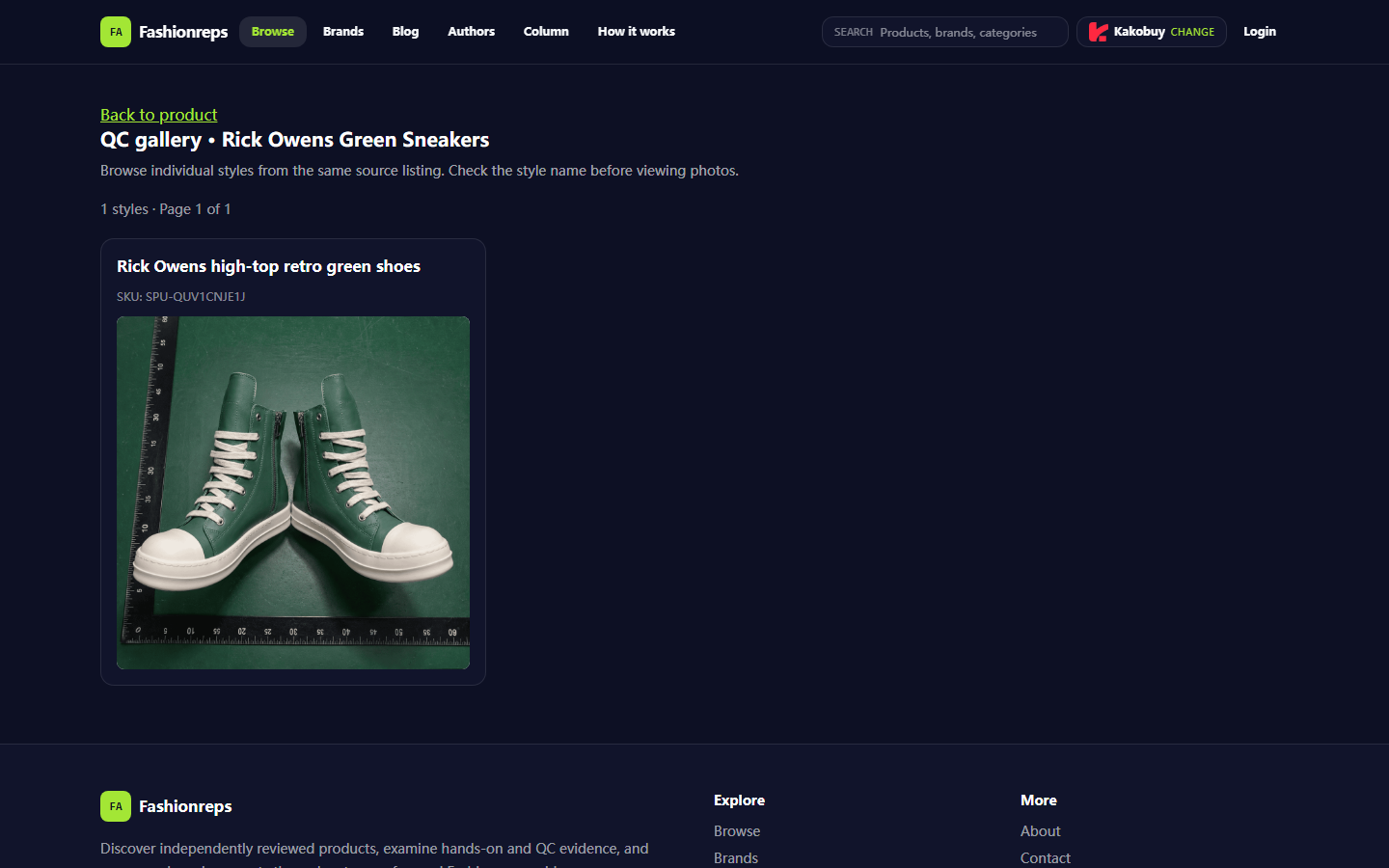
Image: Example of a QC page for a Rick Owens product. The image is only used to identify the page context, not as proof of payment amount, inventory, or product quality.
Specific issue addressed in this Rick Owens payment investigation
The specific symptoms usually fall into one of the following:
- The product page shows one amount, but after entering the purchasing agent, a different product amount appears.
- The product amount looks the same, but the checkout page adds service fees, payment fees, or exchange rate differences.
- The payment amount changes after selecting a different size, color, or style.
- The product page still opens, but the payment page cannot confirm the final amount due.
- The currency, quantity, or payee shown on the pages before and after payment are inconsistent.
After reading this investigation, readers should be able to do three things: confirm they are comparing the same product and the same variant, distinguish the product price from checkout fees, and save enough page evidence for official support to verify.
If the actual issue is QC photo quality, warehouse inspection, logistics routes, or returns/exchanges, those should not be mixed into this payment amount investigation. When an amount cannot be explained, you should not test the system by using another account, repeatedly submitting orders, or clicking payment repeatedly. ⚠️
First verify the product, variant, and current link on the fashionreps product page
First go back to the original product page on fashionreps and record the fields that are directly visible on the page. The example Rick Owens QC page shows the product name, number of styles, and SKU information, where the sample product name is Rick Owens high-top retro green shoes and the SKU is SPU-QUV1CNJE1J. These fields can only be used to confirm the page identity, not to infer price, inventory, or seller identity.
It is recommended to record in the following order:
- The full text of the product title, including high-top, low-top, shoe color, or other style descriptions.
- SKU, product number, or any unique identifier field shown on the page.
- The currently selected color, size, and quantity.
- The currency, amount, and any note next to the amount on the product page.
- The page update time or screenshot time.
- The name of the agent platform that you actually land on after clicking the buy button.
In particular, check whether the page was entered from a different style entry of the same product. The QC page may display independent styles of the same source product; confirm the style name first, then look at the images. If the style name on the product page cannot correspond to the style name on the purchasing agent checkout page, stop first and do not substitute a similar name.
Just because the product page opens does not mean the product is still available for purchase. Redirects, blank pages, broken links, or pages that only show tags without clear product information cannot serve as a basis for payment.
Distinguish product amount, service fees, payment fees, and exchange rate fields
The payment amount should not be judged by just one total. At least split the fields on the page into four categories:
| Field | What to check | What not to infer directly |
|---|---|---|
| Product amount | Whether unit price, quantity, size, or style are consistent | Cannot judge seller or inventory changes solely by amount changes |
| Service fee | Purchasing agent's fees for proxy buying, processing, or warehousing | Cannot treat service fee as product price increase |
| Payment fee | Payment channel handling fees, exchange rate surcharges, or cross-border payment fees | Cannot blame the product page for extra fees |
| Exchange rate field | Settlement currency, conversion rate, conversion time, and rounding method | Cannot substitute mental math for the checkout page amount |
If the payment page shows only a total without listing the components, save a screenshot and ask the actual payee for a breakdown. Do not estimate the final charge based on the product page amount, nor choose an unknown payment channel just to make the amounts "look consistent." 💱
Step-by-step recording method when payment page and product page do not match
It is recommended to create a simple comparison record that includes at least:
- Product page title and SKU.
- Product name and SKU shown on the purchasing agent page.
- Selected size, color, and quantity.
- Product page amount and currency.
- Agent page product amount and currency.
- Service fee, payment fee, and exchange rate fields.
- Total amount due shown on the page.
- Screenshot time, preferably to the minute.
- Payee or payment service name shown on the payment page.
When recording, do not just screenshot the final total. Save separately the product page, cart or order creation page, fee details page, and payment confirmation page. Screenshots should cover name, address, phone, order number, payment card number, account token, and other personal information, but do not cover product name, variant, currency, fee fields, or error messages. 🔒
If the system allows copying order details, save the original text as well; do not alter the amount or time in the original screenshot. If you need to submit materials to the support team, first confirm which fields they require and avoid disclosing complete payment information.
Verification sequence for reloading, switching variants, and keeping timestamps
Follow the sequence below to reduce the risk of mixing different variants or different fee stages:
- Close the old payment page and reopen the product page.
- Verify product title, SKU, size, color, and quantity.
- Record the amount and currency currently displayed on the product page.
- From the current product page, re-enter the purchasing agent; do not use an old cart or old payment tab.
- On the agent page, verify again the same product and same variant.
- Expand all fee details and record separately the product amount, service fee, payment fee, and exchange rate.
- Only enter the payment confirmation page after confirming the amount breakdown.
- Compare total, currency, payee, and payment method.
- If the amount changes again, save new timestamp and page evidence; do not create duplicate orders.
After switching size or color, record the original variant first, then the new variant. Do not compare the new amount after a variant switch with the product amount of the old variant. Quantity changes may also cause the product subtotal to change; the quantity must be clearly stated in the record.
If the amount changes after reloading but the page does not explain why, treat it as an unresolved inconsistency. Reloading can only help confirm page state, not prove that any amount is definitely correct.
When page evidence is insufficient, stop payment and contact official support
Stop payment if any of the following occurs:
- Product name or SKU cannot be matched with the agent page.
- Size, color, or quantity is inconsistent across different pages.
- Currency changes without a clear display of conversion method.
- Total increases without fee details.
- Payee shown on the payment page differs from the selected purchasing agent.
- The page requires transfer via a personal account or private chat that cannot be verified.
- Duplicate orders, duplicate charges, or unclear payment status appear.
- Order status cannot be confirmed after refreshing, going back, or re-entering.
- Support team cannot explain the difference between product amount and fee amount.
For official help, prioritize the help center, ticket system, or account support entry on the official website of the purchasing agent that actually handles the order and payment. The fashionreps product page is for discovery and verification of product context and cannot replace the external agent's order and payment records. When contacting them, submit desensitized product title, SKU, variant, amount, currency, timestamp, and fee details. Do not submit full payment card, password, verification code, passport, or complete shipping label.
If the support team asks you to pay again, first confirm whether the original order has been canceled, whether there are pending charges, and whether the new payment link belongs to an official account. Do not keep multiple identical orders at the same time, and do not skip fee confirmation just to save time. 📩
Do not infer inventory, seller, or product quality from amount anomalies
An amount change alone cannot prove the following:
- The product is out of stock.
- The seller changed or raised the price.
- The product is counterfeit or of poor quality.
- The QC images correspond to a different pair of shoes.
- The purchasing agent must have a system malfunction.
- A lower price means better value.
These conclusions require corresponding page or support records. Product quality should be judged by visible QC materials, size information, defect descriptions, and return/exchange conditions; inventory should be confirmed by the actual agent page or official support; seller and source information also requires clear page evidence. This article does not provide real-time payment page amounts, so it cannot confirm whether there is a current platform fault or fixed price difference.
Safe next-step checklist after completing the review
After completing the review, choose the next step based on the results:
- Amount, variant, currency, and fee details all consistent: save records, then confirm the payee and order status on the payment page.
- Product amount consistent, but service fee or payment fee different: continue only if fee details are clear and explained by the actual purchasing agent.
- Total differs due to exchange rate: verify conversion currency, exchange rate time, and payment channel rules; do not override the checkout page with manual calculations.
- Product or variant cannot be matched: stop payment and re-confirm the source from the product page.
- Total cannot be explained: stop operation and submit desensitized evidence to official purchasing agent support.
- Charge already occurred but order status unclear: do not pay again; first confirm the original transaction status.
Cost-saving options can only be calculated after the fee details are complete. For example, choosing a lower-fee payment method may reduce fixed handling fees, but may also increase exchange rate fluctuations, refund time, or dispute handling difficulty; using another agent may lower a certain service fee, but may bring different warehousing, return/exchange, or support conditions. The exact savings must be calculated from actual page records for the same product, same variant, same quantity, and same currency, not from promotional prices.
Those suited to continue verification are buyers who can confirm product identity, accept the external purchasing agent's rules, and are willing to keep page evidence. Situations not suited to continue payment include unclear amount sources, unverifiable payee, duplicate order status, or no formal explanation from support channels. In such cases, stopping the operation itself is an effective payment security check.
Article image