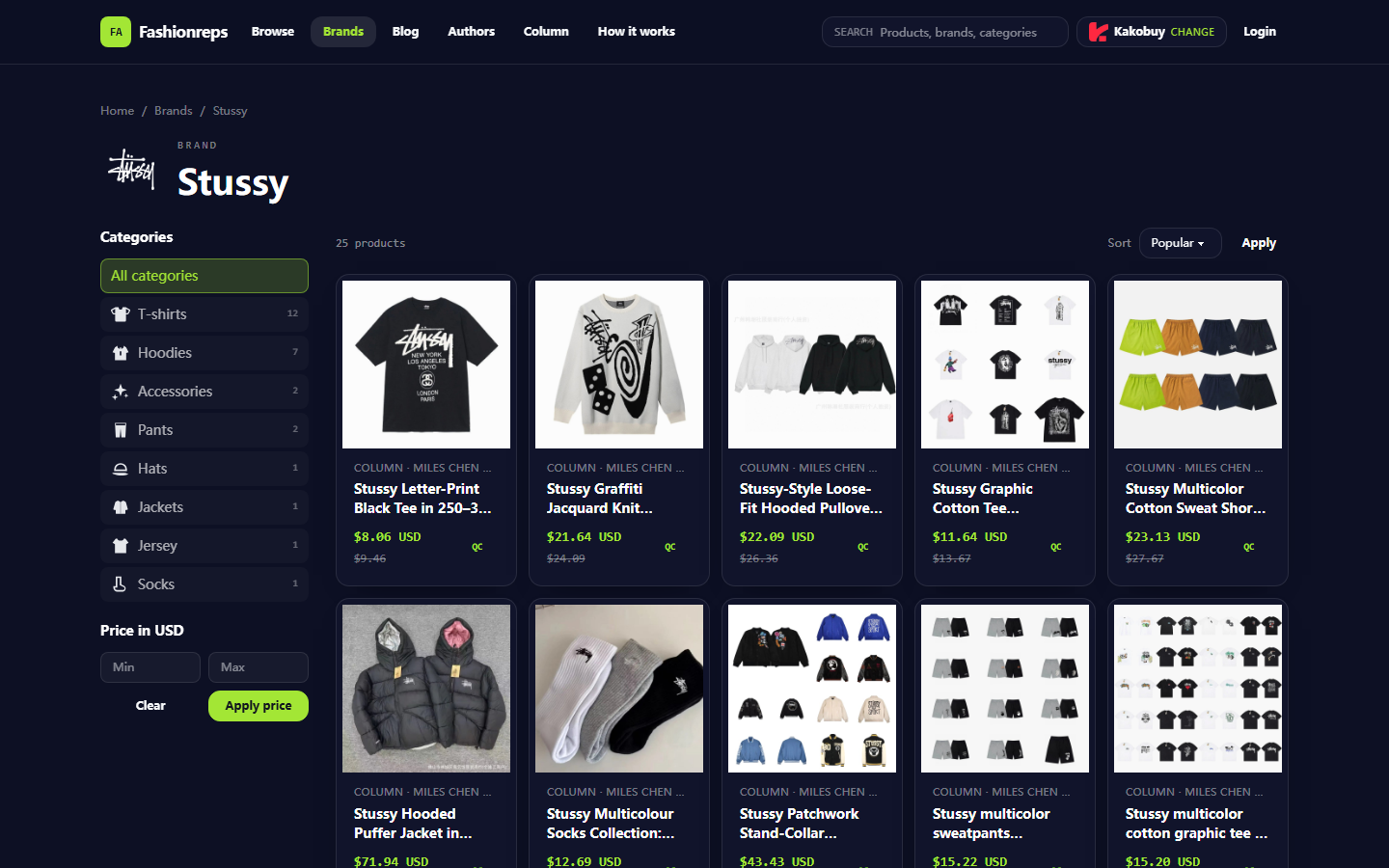

Image: Fashionreps Stussy brand catalog page and accessories filtering task reference.
The Specific Problem This Stussy Accessories Filtering Solves
If you want to first find items worth verifying from Stussy accessories, then organize the candidates into a reviewable list, the easiest thing to confuse is two tasks: discovering products and managing products.
Fashionreps's website-style spreadsheet is better for starting from the brand catalog, categories, and product cards; Google Sheets is better for organizing the candidates you've already discovered by type, specs, link status, and verification date. The two are not interchangeable shopping platforms, and you cannot rely solely on table notes to confirm inventory, materials, or final transaction prices.
The actionable goal of this article is: first filter accessory candidates on Fashionreps's Stussy page, then copy product links to Google Sheets to complete a basic link verification and layered information recording. Page features and catalog information are described as seen on October 9, 2026; prices, inventory, and link status still need to be reconfirmed when you're ready to buy.
This article does not apply to scenarios where you want to directly confirm authenticity, judge actual wearability, infer seller reliability, or determine size, material, and after-sales conditions without opening the product page. 🧭
How to Use Fashionreps Spreadsheet's Category Page and Product Cards
After opening Fashionreps's Stussy brand catalog, first look at the category and filter options the page provides. Currently visible categories include T-shirts, Hoodies, Accessories, Pants, Hats, Jackets, Jersey, and Socks, with Accessories showing 2 products, and Hats and Socks also having visible quantities. This number only indicates the current display size of the catalog page, not inventory quantity.
When filtering, it's recommended to follow this order:
- First go to the Stussy brand page rather than relying directly on site search results.
- Select Accessories; if you're looking for hats or socks, check Hats and Socks separately.
- Look at the product card's title, category, reference price, and available preview information.
- Only add products relevant to your actual task to the candidate list, such as needing hats, socks, or other accessories, rather than saving all Stussy clothing.
- Open the product detail page to confirm the product name, images, visible options, and product link match.
The catalog page currently shows accessory-related product cards like Stussy heart multicolor beanie collection. The reference price on the product card is display information and should not be treated as the checkout price, tax-inclusive price, shipping-inclusive price, or final payment amount.
Fashionreps also provides a purchase platform selection entry; the page explains that the Buy button will redirect to the selected shopping agent. This entry helps continue the purchase process but does not mean different agents have the same shipping costs, service fees, route restrictions, or after-sales rules. After entering the agent page, you still need to reconfirm the product link and order conditions. 🛒
How to Organize Accessory Types and Specs with Filters in Google Sheets
Google Sheets's role is to turn scattered candidate information from the catalog and product pages into a worksheet that can be checked repeatedly. It's recommended to keep only fields that will actually help decision-making initially:
| Field | Purpose | Recording Principle |
|---|---|---|
| Product Name | Distinguish different candidates | Use the name visible on the product page; do not add model numbers yourself |
| Accessory Type | Filter hats, socks, or other accessories | Based on page category or product description |
| Visible Colors or Options | Narrow down candidates | Write "No description visible" when not clearly shown |
| Product Page Link | Return to the original page for review | Paste the complete link; avoid saving only a short title |
| Link Status | Distinguish openable, redirected, invalid, or pending review | Record the date of each check |
| Reference Price | For initial comparison | Indicate currency and verification date; not considered final price |
| Notes | Save questions to confirm | For example, "Need to confirm inventory" or "Need to check size description" |
After building the table, use filters to filter by "Accessory Type," then narrow down by color, visible options, or link status. Don't write all complex judgments into one long note, otherwise it will be hard to distinguish facts, guesses, and to-do items later.
A safer approach is to divide information into three layers:
Clearly observed facts, such as the product page showing a certain color, product name, or reference price.
Content that requires opening the page to confirm, such as material, size, inventory, and seller information.
Content that cannot be inferred from the page, such as actual wearing comfort, real thickness, authenticity, or final logistics costs.
After organizing this way, Google Sheets is a verification worksheet, not a way to disguise unconfirmed descriptions as product data. 📋
How to Record Image Previews, Product Descriptions, and Visible Options Separately
Product images are useful for helping you judge whether a candidate belongs to the target accessory, but images do not necessarily prove that material, size, thickness, or color are completely consistent across different screens.
It's recommended to record the following separately in Google Sheets:
- Whether the image loads normally.
- Whether the image shows a single item, a bundle, or multiple color examples.
- Whether the product title matches the style in the image.
- Whether the page clearly lists colors, sizes, or other options.
- Which information is only visible in the image and which is explicitly stated in text.
If the image shows multiple colors but the product page does not clearly list available colors, do not fill in all image colors as purchasable options. You can record it as "Image shows multiple colors, page options pending confirmation."
Similarly, seeing knit texture, prints, or brim shape does not allow you to determine specific material or weight. Images are for discovery and initial screening; text fields and product detail pages are for further verification. 🧢
How to Verify Product Link Copying, Opening, and Invalid Status
After initial screening, copy product page links one by one to Google Sheets. Do not save only search page links, brand page links, or addresses with temporary filter conditions, because these links may not directly return to the specific product.
It's recommended to check each link following these steps:
- Copy the address from the product detail page, not manually concatenating links.
- Open the copied address in a new browser tab.
- Confirm the page still shows the same product name as in the table or sufficiently clear product identification information.
- Check if the page redirects to a blank page, brand homepage, tag page, or error page.
- Record the check date and result, such as "Openable," "Identifiable after redirect," "Insufficient page info," or "Invalid, to be replaced."
- If the page requires selecting a shopping agent, complete the agent selection first, then confirm whether the product the Buy button points to is still the same record.
"Able to open" does not necessarily mean "directly purchasable." The page may still lack inventory, specs, seller, or shipping information. Therefore, link status should at least be recorded separately from product information completeness; do not set up just one "valid" column and end the verification.
When a link redirects to another page, first determine whether it is a normal redirect or has lost product context. Only when the new page can still identify the same product can you mark it as "Identifiable after redirect."
Division of Labor: Quick Discovery on Mobile and Deep Organization on Desktop
Mobile is better for quickly browsing the brand catalog, viewing images, and noting down a few candidates. When discovering products, you can first record the product name and page address to avoid entering a lot of fields on mobile.
Desktop is better for handling filters in Google Sheets, batch pasting, freezing header rows, checking for duplicate links, and adding verification dates. When the number of candidates is large, it's recommended to complete the following tasks on desktop:
- Filter by accessory type.
- Remove duplicate product links.
- Check whether product names and images correspond.
- Mark records missing specs, colors, or inventory information.
- Separate invalid links from pending review links.
- Group into "Continue verification," "Insufficient info," and "Invalid."
If you just want to quickly find one accessory, using Fashionreps's category page directly may save steps. If you need to compare multiple candidates, collaborate with friends, or review links later, Google Sheets is more suitable as an organizational layer. The advantage here is the recording structure and filtering capability, not untested loading speed or purchase success rate.
Which Page Facts Cannot Be Inferred from Table Notes
Table notes can only save verification results and cannot replace real-time information from product detail pages or shopping agents. The following must be reconfirmed before actually placing an order:
- Whether the product is still in stock.
- Whether selectable colors and sizes still exist.
- Whether the material shown on the page has clear textual evidence.
- Whether the reference price has changed.
- How shipping, service fees, taxes, and exchange rates are calculated.
- Whether the shopping agent accepts the product link.
- Return/exchange windows, warehouse inspection, and after-sales handling conditions.
- Destination country's import restrictions and declaration requirements for the relevant product.
Do not skip product page verification just because the table says "purchasable," and do not write "good quality" just because "image is clear." If there is no clear evidence for an item, using "pending confirmation" is safer than filling in a seemingly complete answer.
Next Steps After Completing the Stussy Accessories List
When the list is complete, continue in this order:
- Remove duplicate links and keep the last verification date for each candidate.
- Reconfirm name, image, options, and reference price for product pages that are still openable.
- List items with insufficient information separately, not mixed with complete candidates.
- After selecting a shopping agent, check the product link corresponding to the Buy button and the agent's fee description.
- Confirm inventory, specs, shipping, taxes, warehouse inspection, and after-sales conditions before placing the order.
- After receiving warehouse photos or inspection information, decide whether to combine, split, or ship.
The final decision can be made with a simple principle: Fashionreps is for discovering and entering product pages, Google Sheets is for classifying, recording, and reviewing, and the shopping agent page is for confirming actual order conditions. When the three sources of information conflict, the current openable product page and agent settlement information prevail, not old notes. ✅
This method mainly saves time on repeated searching and checking, not guaranteeing cheaper products. It is suitable for people who need to organize multiple Stussy accessory candidates, collaborate with others, or keep review records; if you're only looking at one product, building a complete table will increase organization costs. It is not recommended to place an order based solely on table records when links have expired, product details are insufficient, or destination country fees and import requirements cannot be confirmed.
Article Image

Agent Platform Shopping FAQ
1. Why not use Google Sheets on usfansus.com?
Google Sheets works well only for product lists with a small number of entries. As the product count grows on usfansus.com, the sheet becomes sluggish and takes a long time to load, especially on mobile devices where the layout looks cramped and product searches become frustrating. For the same catalog, usfansus.com presents its spreadsheet faster and with a much better visual layout.
2. Is the usfansus.com spreadsheet website secure?
usfansus.com does not gather any personal details; it functions only as a product directory for the agent platform. All buying and selling happens on the agent platform itself.
3. What kinds of products can I find in the usfansus.com spreadsheet?
The usfansus.com spreadsheet includes footwear, clothing, bags, accessories, jerseys, perfumes, hats, scarves, belts, and a range of household living items.
4. What does a QC photo mean on usfansus.com?
Every drop-shipping service connected to usfansus.com has a dedicated quality control staff. After your order reaches their warehouse, they perform a quality check and take QC photos of your goods. Typically, three images are captured, and the team confirms that the color, size, specifications, and quantity match your order while also looking for any defects. This does not apply to electronic items, where only the outer surface is examined. If they find quality problems or wrong size or color, they promptly request a return from the seller. This process helps ensure the products you get are of good quality.