Clarify the Task and Evidence Boundaries for trapstar Fall/Winter Hoodie Candidates
This guide addresses a specific task: when you see multiple Trapstar hoodies in the fashionreps website-style product catalog and need to filter fall/winter candidates, preserve traceable QC entry points, and decide whether to organize candidates into Google Sheets, how to avoid mixing similar titles, different styles, and broken links.
After reading, you should be able to do three things: create a candidate list, preserve page and QC clues for each candidate, and pause before ordering to recheck information that is still missing or outdated. This article does not judge authenticity, actual quality, material feel, inventory, or seller reliability, nor does it treat QC photos as proof of quality. Page information and product links may change, so you need to reopen the original page to confirm before publishing or ordering.

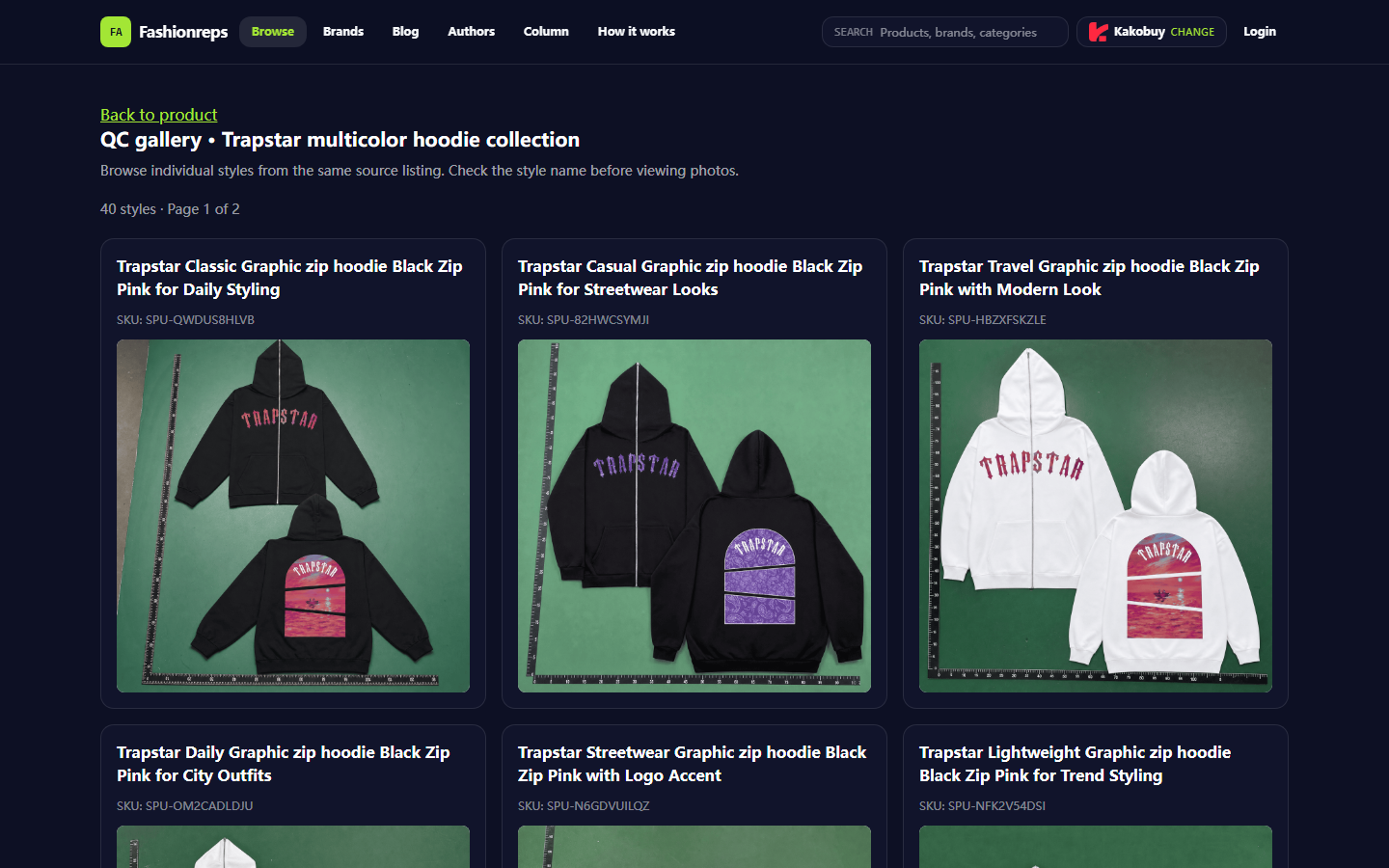
Image: Example of visible fields on the fashion-reps Trapstar multi-style hoodie QC catalog page.
Verify trapstar Product Catalog, Images, and Links in the fashionreps Website-Style Spreadsheet
The currently visible Trapstar QC page displays multiple styles from the same source list in a catalog format. The page indicates there are 40 styles, divided into two pages; each entry shows a stylized product name and SKU, for example "Trapstar Classic Graphic zip hoodie Black Zip Pink for Daily Styling," and provides an entry to the corresponding QC gallery.
This browsing method is suitable for initial candidate discovery. You can first observe:
- Whether core product information such as Trapstar and hoodie is indeed included.
- Whether color descriptions appear in the product name, for example Black, Zip Pink and other fields.
- Whether the first part of the product name distinguishes different styles, or whether it simply reuses similar templates.
- Whether the SKU is preserved and can lead back to the same product or QC page.
- What page you are on, and whether there are additional pages or more candidates not yet viewed.
- Whether the product page opens normally and shows a clear name, images, and sufficient visible fields.
The page also displays navigation elements such as on-site search, brand browsing, product catalog, and QC gallery. The purchase platform selection menu on the page includes multiple external shopping agent options, but this only indicates that the page provides redirect choices and cannot prove that a particular agent currently has stock, price, shipping, or available routes.
When verifying, it is recommended to enter the detail or QC page from the product entry, rather than just copying the title from the list. If after opening there is only a blank area, redirect, 404, pure tab page, or you cannot see a clear product name and images, mark that candidate as "pending review" and do not treat it as a valid product page.
Use Google Sheets to Build Fields for Color, Size, QC Entry, and Update Time
The website catalog is good for discovery and one-by-one viewing, while Google Sheets is better for placing multiple candidates on the same table for comparison. The table should not replace the original page, but should preserve clues to the original page and verification status.
It is recommended to at least create the following fields:
candidate_name: Product name shown on the page.brand: Brand field visible on the page or brand word in the name.category: For example hoodie, zip hoodie, or other categories explicitly shown on the page.color_text: Preserve the color description from the page verbatim; do not merge color names on your own.style_descriptor: For example Classic, Casual, Travel, Daily and other distinguishing words in the name.sku: SKU shown on the page, as a candidate tracking clue.product_page_status: Valid, pending review, invalid, or not checked.qc_entry_status: Found, not found, entry abnormal, or not checked.qc_note: Only record what is actually visible on the page, e.g., "has QC gallery entry" or "page indicates 40 styles."size_info: Size information explicitly shown on the page; if not seen, fill in "not shown," do not infer size range.image_status: Has image, no image, image loading error, or not checked.source_page_checked_at: Date and time of last opening the page.next_action: Continue checking, wait for page recovery, confirm with seller, or exclude candidate.
Status words in the table should remain fixed to avoid writing "available" at one time, "valid" at another, and "normal" at yet another, which would break filtering conditions. For fields without supporting evidence, using "not shown" is safer than filling in guesses. 🧾
Compare Title, Variant, Image, and Product Link Item by Item for Each Candidate
When filtering, use SKU or a stable product page identifier as the primary key, not just the title. The current catalog has many similar Trapstar graphic zip hoodie names; titles may share color and category descriptions, but style words, SKUs, and image entries differ.
You can check each candidate in the following order:
- Copy the complete product name and SKU from the page.
- Record the color text shown on the page; do not merge similar colors into one color.
- Open the product detail or QC page and confirm that the name matches the catalog entry.
- Check that the images belong to the current candidate and not to other styles from the same source list.
- Record the product page and QC page as separate fields; do not use one address to substitute for two evidence entries.
- Record the date the page was opened, and compare name, images, and status for changes during later rechecks.
- Only fill in size, price, inventory, material, or seller information when the page explicitly shows it.
The division of labor between the website catalog and Google Sheets can be understood as follows:
| Task | Website-Style Spreadsheet or Catalog | Google Sheets |
|---|---|---|
| Discover candidates | Browse by brand, catalog, and page navigation one by one | Perform secondary filtering based on existing candidate table |
| View images | Enter product page or QC gallery to view original page content | Save image status and review notes, not a substitute for original images |
| Distinguish styles | Rely on name, variant, SKU, and page context | Split color, style words, and status using fields |
| Track changes | Reopen the page each time to confirm | Use update time and status to filter items pending review |
| Collaborative organizing | Suitable for raw verification of a single page | Suitable for multiple people to add notes and assign review tasks |
Google Sheets filtering, sorting, and collaboration can only improve the organizing process, not add facts that the original page does not provide. If the original page has no size or price, the table should also remain empty or be marked as not shown. ✅
Compare Applicable Scenarios of Website Catalog Browsing and Table Filtering for Multi-Candidate Tasks
When the number of candidates is small and you are not yet familiar with the catalog structure, use the website page first. Page context helps you see associated entries such as brand navigation, product categories, QC gallery, and purchase agent options, and also makes it easier to discover whether a candidate is just one entry among similar titles.
When the number of candidates increases, or you need to repeatedly filter by color, SKU, QC status, and update time, then put the verified candidates into Google Sheets. At this point, the value of the table is to reduce repeated openings and omissions, not to judge image quality or product authenticity for you.
A practical two-stage workflow is:
- Stage 1: Discover candidates in the website catalog, open pages one by one, and exclude empty pages and entries that cannot be matched.
- Stage 2: Enter valid candidates and their missing fields into Google Sheets, and use fixed statuses to manage subsequent rechecks.
- Stage 3: Return to the original page to handle items marked as pending review in the table.
- Stage 4: Before ordering, reconfirm product page, variant, QC entry, and update time.
Do not copy the entire catalog page into a "confirmed list" at once. The 40 styles shown in the catalog only indicate page scope information, not that all 40 candidates have completed image, link, size, and QC verification. 📌
Record QC Clues, Missing Fields, and Link Status Without Inferring Quality or Authenticity
The purpose of QC clues is to help you find pages that need further inspection, not to draw quality conclusions for you. You can record visible facts such as "has QC gallery," "page shows multiple styles," "image entry can be opened," but do not write "good quality," "excellent details," "authentic," or "passed inspection."
When checking images, you can focus on the following recordable items:
- Whether images are loaded.
- Whether the images correspond to the current name or SKU.
- Whether the page is explicitly marked as QC photos or QC gallery.
- Whether there are multiple styles, and whether the current image can distinguish the specific style.
- Whether the images are sufficient to support your next step of asking the seller or shopping agent.
The following content cannot be inferred solely from catalog or QC images:
- Material thickness, warmth, and actual wearing comfort.
- Whether the fit is accurate and whether the size suits your body type.
- Durability of prints, embroidery, or zippers.
- Whether the product is authentic or authorized by the brand.
- Whether the sample in the images is completely identical to the final shipped product.
If the images do not match the title, or the same SKU shows different names on different pages, change the status to "pending review," keep records of both checks, and pause ordering. Do not cover up conflicts by editing the title. 🔍
Pause and Recheck Process for Outdated Data and Page Inconsistencies
Product names, images, sizes, inventory, prices, purchase agents, and links can all change. The update time in the table only indicates when you last checked, and does not guarantee that the current page remains the same.
Pause moving a candidate into the ordering list when any of the following occur:
- The page cannot be opened, redirects, or returns a 404.
- The catalog name does not match the detail page name.
- SKU is missing, duplicated, or does not match the QC page.
- Images cannot be loaded, or images clearly belong to another candidate.
- Size, color, price, or inventory fields change, but the table lacks a new verification time.
- The QC entry disappears from the page, or only an incomplete blank area is visible.
- The purchase agent menu is still visible, but actual ordering, payment, or shipping conditions cannot be confirmed.
When rechecking, do not directly overwrite old records. You can add a new column to record the latest status, or keep a brief change note, e.g., "2026-10-15: catalog name still visible, QC entry needs reopening." This distinguishes historical observations from current confirmations and avoids duplicate checks during multi-person collaboration. 🕒
Pre-Order Candidate List and Next Actions
After initial screening, each candidate that you plan to continue researching should at least have:
- An openable product page.
- A product name and SKU clearly shown on the page, or an explanation for any missing ones.
- Recorded color and style descriptions.
- Confirmed or clearly marked QC entry status.
- Image status and last verification time.
- Explicit marks for fields not shown, such as size, inventory, price, shipping, and taxes.
- A specific next action, e.g., reopen the page, confirm size with seller, or exclude candidate.
If you are only organizing candidates, it is recommended to keep the combination of "original website information + structured Google Sheets record." It saves time on repeated searches, but does not eliminate risks from page changes, broken links, or insufficient product information.
Before making the final decision, reopen the original product page and QC page to confirm that the current name, variant, images, and links remain consistent. For quality, authenticity, inventory, price, shipping, taxes, and after-sales conditions that cannot be proven by the page, keep them unconfirmed until you obtain a clear source or seller confirmation.